
Meet the team Q&A: Yue Ren

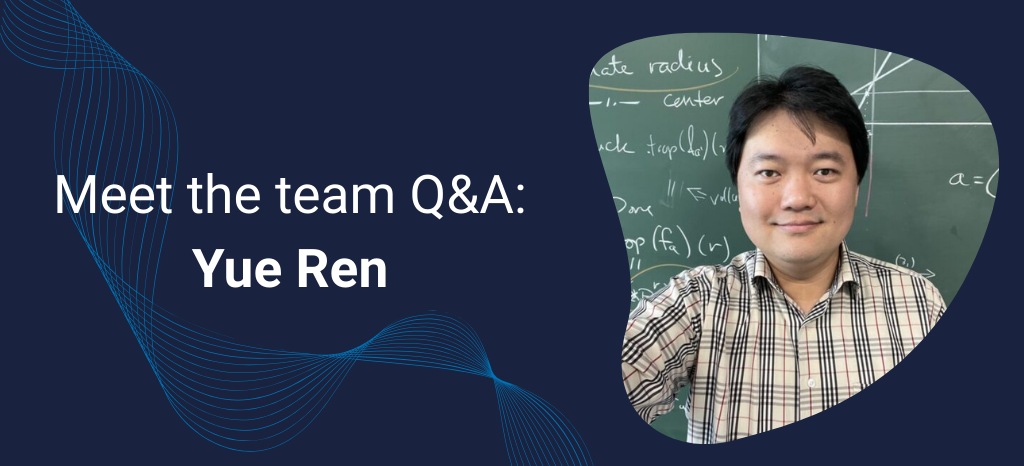
In this Erlangen Hub Q&A we spoke to Yue Ren, Co-Investigator and Theme B lead at Durham University. Yue is a UKRI Future Leaders Fellow and leading expert in tropical geometry, mathematical software, and the application of both to neural networks and problems in industry and sciences. He is a core developer of the computer algebra systems Polymake, Singular, and OSCAR.
What is your name?
Yue Ren
Can you share a bit about your background and your current research focus?
My background is in algebraic and tropical geometry. I did my PhD in Germany, and spent some time in the US, South Africa, Israel, and Sweden before moving to the UK. My current focus is on applications of the latter to polynomial system solving and machine learning.
What inspired you to pursue this area?
Mathematically, I’ve always been fascinated by the concrete interplay between algebra, geometry, and combinatorics in tropical geometry. However, I was always prone to making mistakes in hand calculations, so I decided to specialize in teaching a computer to do them for me instead. Professionally, I wanted a path that combined my mathematical interests with practical skills like software development.
Which themes are you connected to within the Erlangen AI Hub and how does your work within the hub intersect with your research background?
I am mainly connected to Theme B, though my research touches upon other themes as well. My work within the hub revolves around taking theoretical techniques from pure mathematics and turning them into practical algorithms. It’s a way to expand the machine learning toolbox with some interesting new tools.
What attracted you to the Erlangen AI Hub and what do you hope to see it achieve?
The Erlangen AI Hub brings together researchers from a wide range of backgrounds who are all pursuing a common goal. I’m really looking forward to the mathematical theories and practical tools that will come out of this unique mix of expertise.
What’s been the most surprising or exciting finding in your work so far?
I’ve found it really surprising that p-adic numbers, an abstract number system developed by pure mathematicians for number theory, can be so useful for data analysis. Their distance prioritizes structural relationships over physical proximity, which is perfect for hierarchical data.
What challenges have you faced in your research, and how did you overcome them?
Most researchers face the same problems: getting stuck on a proof, getting unstuck only to realize you’ve built a suspiciously complicated proof for a simple statement, and Reviewer 2. Research is an endless chain of challenges, and the best strategy for overcoming them is to ask for advice, ask for feedback, and act on it. Not only are advice and feedback valuable, but asking for and acting on them is also a valuable skill that needs to be trained.
What advice would you give to someone just starting out in your field?
Don’t just focus on doing things, reflect on how you do them. Finding better work habits will help you spend more time on the things you enjoy and less time on the things you don’t.
What’s something people might be surprised to learn about you outside of research?
I’ve participated in the Cape Argus Cycle Tour, a 110 km race around the Cape of Good Hope with 35k entrants. I finished in the middle of my age group while taking 300 pictures along the way. I was beaten by a group dressed up as the Power Rangers under the ruthless South African sun, but at least I managed to beat that one bloke who rode a unicycle.