The Erlangen AI Hub Conference will bring together leading researchers, innovators, and thinkers at the forefront of artificial intelligence. Further details to be announced shortly.
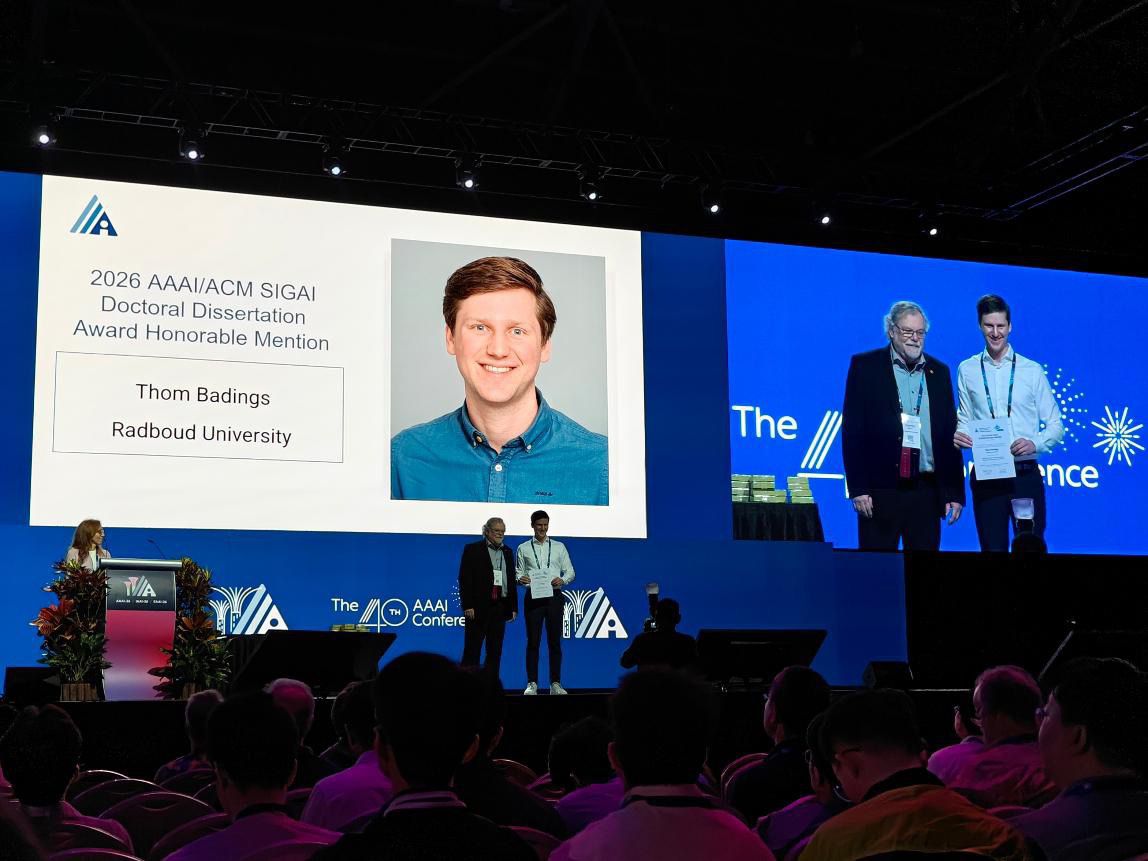
Erlangen Hub researcher Thom Badings has received an honourable mention in the AAAI and ACM SIGAI Doctoral Dissertation Award; a prestigious international award recognising outstanding PhD research in artificial intelligence. As part of this recognition, Thom was invited to attend AAAI 2026 in Singapore, where he received the award and delivered an award talk on his doctoral research.
The AAAI and ACM SIGAI Doctoral Dissertation Award is jointly presented by the Association for the Advancement of Artificial Intelligence, and is regarded as one of the most significant distinctions for early-career researchers in the field. Honourable mentions are awarded to dissertations that demonstrate exceptional originality, technical depth, and potential impact.
In addition to the award presentation, Thom and Hub PDRA Francesco Fabiano also presented their joint research paper on robust decision-making, developed in collaboration with Co-investigators Alessandro Abate and Giuseppe De Giacomo.
Thom will be leaving the Erlangen AI Hub in March. His recognition at AAAI 2026 reflects both the strength of his individual research contributions and the broader impact of the Erlangen Hub’s work in artificial intelligence.
The Erlangen Hub has achieved a significant international research milestone, with over 20 papers accepted at ICLR 2026, one of the world’s leading conferences in artificial intelligence and machine learning.
The International Conference on Learning Representations, known as ICLR, is a premier global venue for research in areas such as deep learning, reinforcement learning, and the theoretical foundations of modern AI, and will be held in Rio de Janeiro, Brazil, from Thursday 23 April to Monday 27 April.
ICLR 2026 had over 19,000 paper submissions from researchers worldwide, with an acceptance rate of only around 30 percent. For Erlangen, securing over 20 papers in a single year is an excellent outcome. This success ensures the Hub remains a productive contributor to the conference internationally and the wider AI research conversation.
The accepted papers are diverse. They span a wide range of topics at the forefront of AI research, reflecting both the breadth and depth of expertise within the Hub. They include work on reinforcement learning, causal inference, diffusion models, and the theoretical analysis of machine learning systems, alongside several high-profile collaborative projects.
Hub Director Michael Bronstein and colleagues contributed an exceptional 17 papers.
Other contributors include Ran Levi, whose collaborative project paper develops new topological neural network models for learning from complex, higher-order relational data. Alessandro Abate also co-authored an accepted paper with L. Carvalho Melo and Yarin Gal, on challenges in reinforcement learning for large language model reasoning.
The Erlangen Hub is further represented in foundational work on causality and learning, with Marta Kwiatkowska co-authoring an accepted paper on causal imitation learning in the presence of hidden confounders, while Patrick Rebeschini co-authored a paper offering new theoretical insights into diffusion models, an increasingly important class of generative models in modern AI.
In other conference news, Hub PDRAs Francesco Fabiano and Thom Badings presented the paper “Best-Effort Policies for Robust Markov Decision Processes”, a collaboration with Co-Investigators Alessandro Abate and Giuseppe De Giacomo, at the AAAI 2026 conference in Singapore. Thom also received an honourable mention in the AAAI and ACM SIGAI Doctoral Dissertation Award and delivered his own talk at AAAI 2026. Hub Co-I Gesine Reinert has contributed two papers this year to the AIStats conference, taking place later this year in Morocco.
Taken together, these achievements highlight the Erlangen Hub’s growing international profile and its impact across the most active and influential areas of artificial intelligence research. They reflect both individual research excellence and a strong culture of collaboration and high-quality scholarship within the Hub.
Researchers across the Erlangen AI Hub continue to showcase their work on the international stage. This season, Hub members presented at the IEEE Conference on Decision and Control (CDC 2025) and NeurIPS 2025, one of the world’s leading AI gatherings. Their contributions span advances in autonomous systems, the mathematical foundations of control, and the growing use of generative AI in finance. The highlights are captured below.
Advances in Abstraction-Based Control at CDC 2025
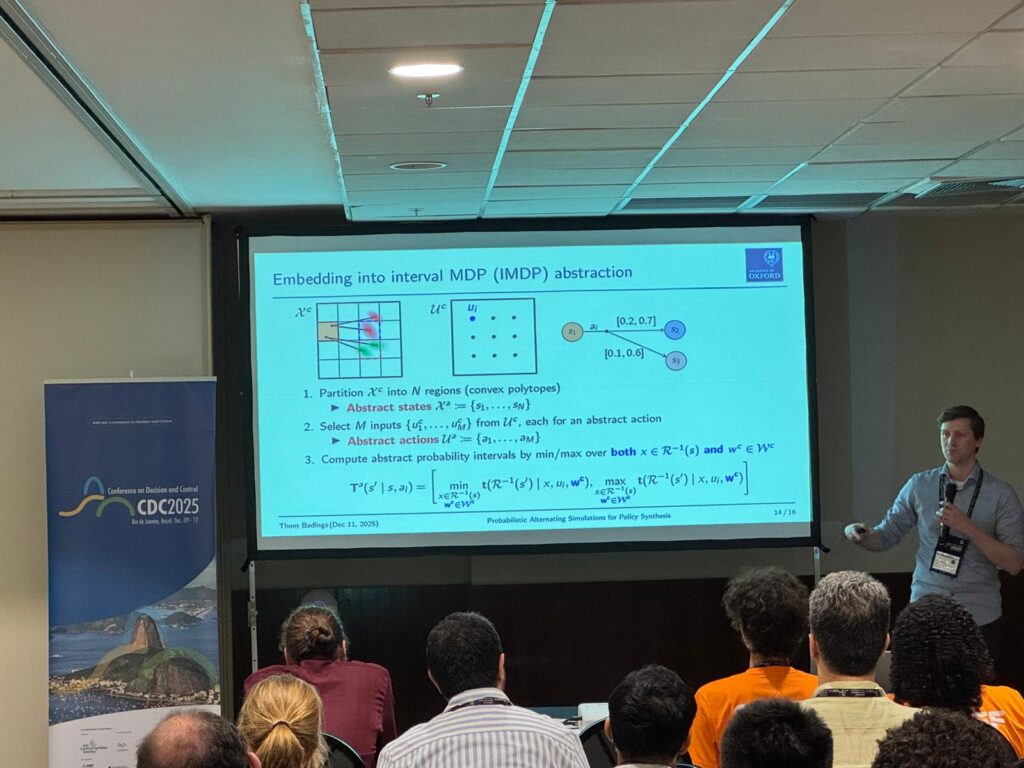
Designing safe, reliable controllers for autonomous systems, from drones to self-driving vehicles, remains a fundamental challenge in AI. At CDC 2025, Erlangen Hub PDRA Thom Badings and Co-Investigator Alessandro Abate presented new research advancing abstraction-based control, a principled approach for computing correct-by-construction control policies under uncertainty.
Their two papers deliver key contributions:
Strengthening the mathematical foundations A refined abstraction framework capable of computing provably safe control policies even when system dynamics are uncertain. This work enhances both precision and scalability for complex autonomous platforms.
Introducing data-driven abstraction methods New techniques for constructing abstractions directly from empirical data, reducing reliance on fully specified analytical models and enabling robust control in partially known environments.
These developments push forward the frontier of reliable autonomous decision-making and contribute to the Hub’s broader mission to develop rigorous foundations for trustworthy AI.
Further reading: Probabilistic Alternating Simulations for Policy Synthesis in Uncertain Stochastic Dynamical Systems https://arxiv.org/abs/2508.05062 • Data-Driven Abstraction and Synthesis for Stochastic Systems with Unknown Dynamics: https://arxiv.org/abs/2508.15543
Generative AI for Finance: Rama Cont at NeurIPS 2025
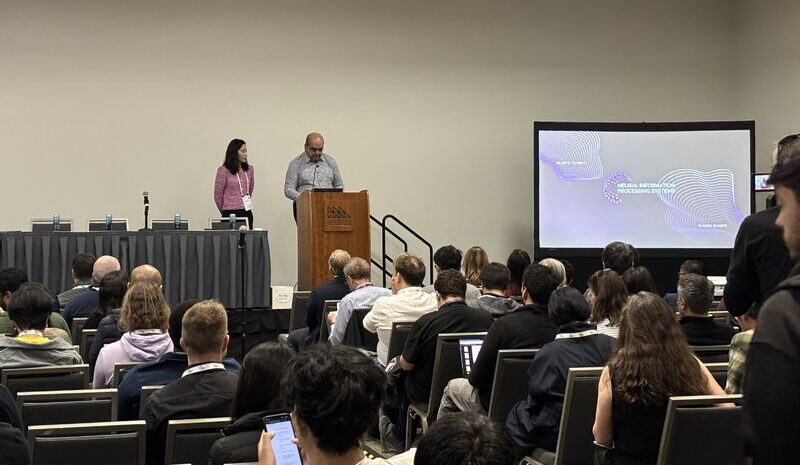
At the NeurIPS 2025 Workshop on Generative AI in Finance, Erlangen Hub Co-Investigator Rama Cont delivered an invited talk on how generative models are transforming quantitative finance.
Financial markets are noisy, nonlinear, and highly interdependent, making simulation and risk assessment especially challenging. Cont presented recent work demonstrating how GAN-based models can emulate complex market behaviour, generate realistic scenarios, and support robust risk management.
His talk covered several key generative approaches developed by Cont and collaborators, including:
VolGAN for stochastic volatility surfaces
Tail-GAN for modelling rare but high-impact tail events
YieldGAN for yield curve dynamics
Data-driven hedging with generative models, a method using conditional generative models to compute hedge ratios across simulated market scenarios
The last of these was the focus of his presentation and recent paper, which proposes a non-parametric approach to hedging that outperforms classical delta and delta-vega strategies, even years after the training period.
The workshop itself featured leading voices from academia and industry, reflecting the rapid growth of AI-driven approaches in financial modelling.
NeurIPS 2025 was among the most competitive editions of the conference to date, with just 24.5% of submissions accepted. Against this backdrop, Erlangen AI Hub Director Michael Bronstein appeared as a co-author on nine accepted papers, presented across poster and spotlight sessions.
These contributions span generative and diffusion models, flow-based methods, equivariant and graph neural architectures, optimisation, and inference. All are core areas in the mathematical foundations of modern AI, and together, they reflect sustained engagement with both the theory and practice of scalable learning systems.
In a conference landscape increasingly shaped by large North American corporations and Chinese research institutions, this level of representation places Bronstein as a key figure in small group of Europe-based researchers maintaining strong technical visibility at NeurIPS, while highlighting the continued contribution of UK and European research to foundational questions shaping the field.