
Meet the team Q&A

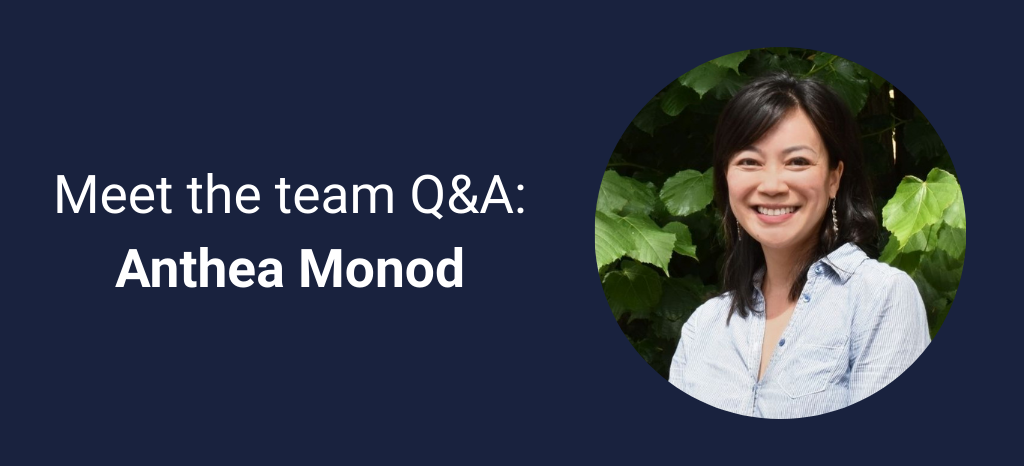
Continuing our Q&As, where hub members kindly answer a set of questions to share more about them and their work, we introduce Hub Co-Director and Imperial Lead Anthea Monod.
Can you share a bit about your background and your current research focus?
My undergraduate degree is in pure mathematics, while my PhD is in statistics. I now work at the intersection of pure mathematics and statistics, data analysis, and machine learning. This uses aspects of my formal training and also provides plenty of opportunities to learn more and explore more ways to use pure mathematics in computation and data science, as well as use computational and data-centric approaches to questions in pure mathematics.
What inspired you to pursue this area?
During my PhD, I missed the pure mathematics that I studied in undergrad but, in undergrad, I yearned for my work to have real-world impact and significance. When I was searching for a postdoc after my PhD, I stumbled on this area by accident. I wanted to work more on the geometry of random fields, and contacted Robert Adler (Technion, Israel) for a postdoc in this area, as he is the world expert in it and literally wrote the book on it. But he informed me that his latest interests are in topological data analysis (TDA), which adapts algebraic topology to the computational setting for data analysis and statistics. Although I had hoped to spend some of our discussions on the geometry of random fields during my postdoc, it turns out that I ended up finding TDA more inspiring and motivating and have been working in that area ever since, also expanding to other intersections as well, including algebraic statistics. Algebraic statistics uses techniques from algebraic geometry to study statistical models, which I am exploring in the extension to machine learning methods and neural networks, mostly using tropical geometry, which is a piecewise linear, combinatorial, and polyhedral variant of algebraic geometry.
Which themes are you connected to within the Erlangen AI Hub?
Initially, while constructing the proposal, I felt most connected to Themes A and B (Understanding Data, Understanding Machine Learning Models). However, recent work that was born out of the hub framework has also produced some work in collaboration with other hub members as well as new connections to industry. So, I have also dabbled in Themes C and D (Understanding Learning, Understanding Decision-Making), especially where we have used algebraic topology to try and understand latent spaces of large language models under adversarial influence.
What attracted you to the Erlangen AI Hub and what do you hope to see it achieve?
I feel very fortunate to be one of the team who founded the idea from the moment that the EPSRC call for proposals went live, together with Jeff, Heather, Jacek, Omer, Primoz, and Michael. Jeff, Heather, Omer, Primoz, and myself have primarily been working on applications of topology to data science, mostly persistent homology, and were interested in developing other areas of algebraic topology to data science, such as K-theory. Heather and I also work both in algebraic statistics and wanted to push further to include algebraic geometry as well, which then grew when Omer proposed a probabilistic grounding to the research with his background, Jeff who suggested category theory, and Michael who has worked a lot in adaptations of smooth and continuous geometry to machine learning as well. Over the lifetime of the hub, I would really like to see more ways that more “exotic” mathematics can be adapted to understand deep learning and AI better and, in that sense, establish and ground the position of mathematics in modern data processing techniques and learning theory. I would also like to see the reach of our work extend beyond academia, and I would like for concepts in pure mathematics that might have been inaccessible or intimidating so far to become more widely-used, or even household concepts!
What’s been the most surprising or exciting finding in your work so far?
I think currently what I’ve been most excited about is the reach of tropical geometry to data settings that I’ve been interested in. I started off with an interest in understanding, analysing, and comparing evolutionary relationships in biology captured by phylogenetic trees. It turns out that tropical geometry is a very powerful framework for doing this, and over the past 7 years that I’ve gone into this direction, together with some wonderful collaborators that I have had the great fortune to meet, I’ve done quite a lot of work in providing guarantees for data analytic questions in tropical geometry. The more I learn about tropical geometry, the more I am realising that it also has connections to other discrete mathematical objects that I am interested in, such as metric graphs, which are also very important mathematical structures to model urban road networks, for example. Perhaps most relevant to the hub, it turns out that tropical geometry also has connections to neural networks, which can be thought of as the engine to modern AI systems. I’ve had the great fortune of supervising wonderful PhD students in this area, one of whom is now a hub PDRA in Durham! And another who is also carrying forward the mission of the hub as a Digital Futures Fellow at KTH Sweden, collaborating with some other well-known researchers in both algebraic geometry and algebraic topology in machine learning, such as Kathlén Kohn (a plenary speaker at the hub’s first public conference) and Martina Scolamiero.
What challenges have you faced in your research, and how did you overcome them?
In such an interdisciplinary field, it’s always a challenge to have the expertise in all of the required areas to make a real contribution. Fortunately, I’ve built a large network of fantastic collaborators from all backgrounds with different expertise. This collaborative spirit of exchange and openness is something that we’ve built into the hub by construction. Nobody knows everything, nobody is an expert in everything, so it’s important to talk to each other and work together, which I’m happy to report has worked well for me so far in the hub, and I hope for this to grow and expand over the lifetime of the Hub.
What advice would you give to someone just starting out in your field?
The area is quite vast and fast-moving, so it can be difficult to know where to start. However, fortunately, there is also a lot of content out there: blog posts, tutorials, vlogs, as well as opportunities for in-person interactions, such as talks, workshops, and conferences. Don’t be afraid to sit in and listen to these talks, to talk to the speakers, or reach out to researchers. Don’t be afraid of not understanding everything, hardly anyone does! Interest is what motivates you to learn, and we need to learn continuously to do the work that we do, so keep up the interest and jump on opportunities to learn more, but also make the time to get serious and do some work as well.
What’s something people might be surprised to learn about you outside of research?
I almost didn’t go to university at all. I almost went to study at a conservatoire instead, but quickly got intimidated by how difficult a career in music is, so settled for the “easier” option of mathematics!