
Erlangen AI Hub Industry Day: Connecting Academia and Industry

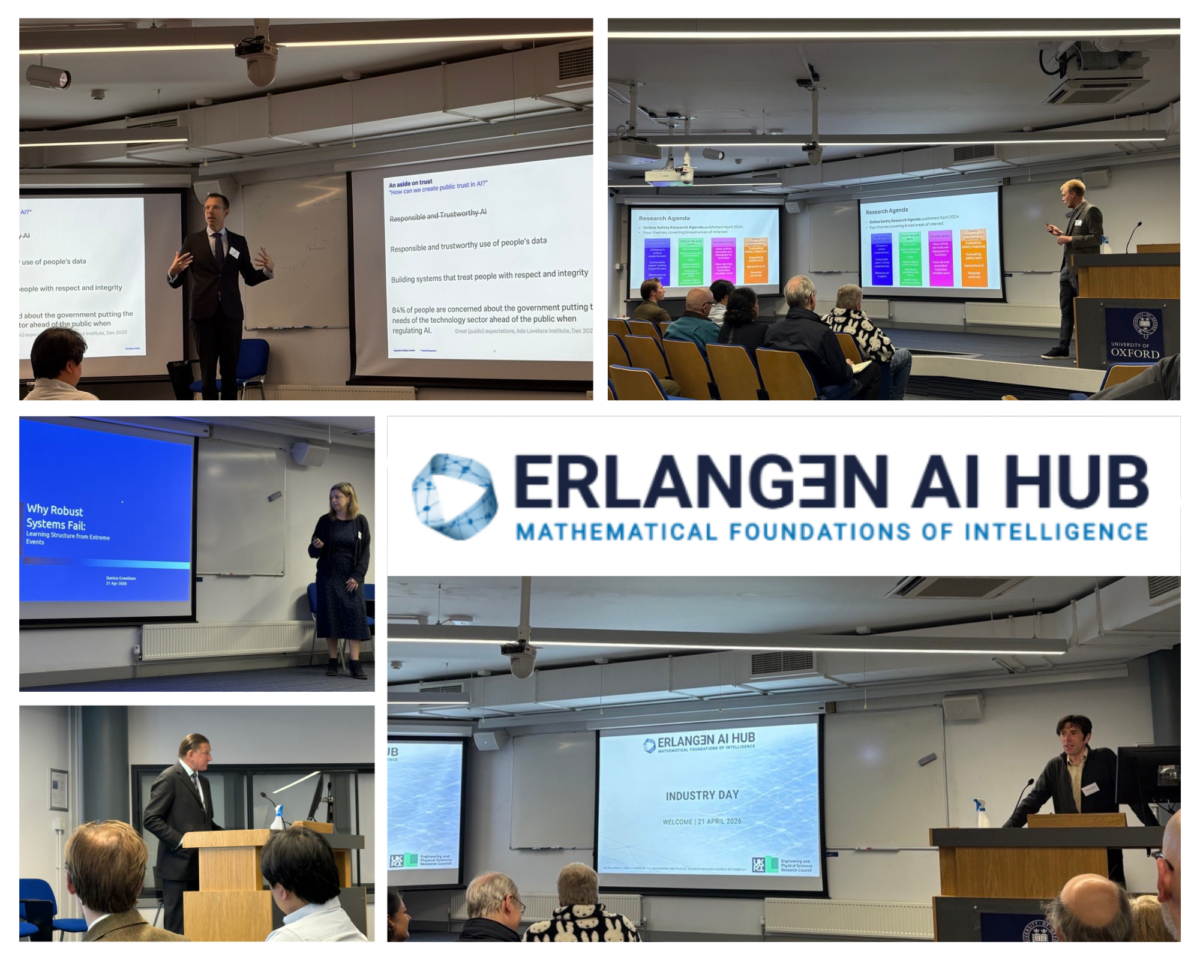
On Tuesday 21 April, the Erlangen AI Hub hosted an Industry Collaboration Day at the Department of Computer Science, University of Oxford. The event brought together academics from across the Hub network alongside leading industry partners, creating a valuable space for discussion, knowledge exchange and future collaboration.
The day opened with a welcome from Jeff Giansiracusa, Professor of Mathematics at Durham University. We were joined by an outstanding group of industry speakers, including Dr Carl Hunter (Durham Institute of Research, Development and Invention), Andreas Haggman (Ofcom), Danica Greetham (Capgemini Engineering), Francis Bursa (Oxford Nanopore Technologies) and Marco Albanese (Oxford Drug Design).
Academic perspectives were provided by Tom Coates, Professor of Mathematics at Imperial College London, and Pete Grindrod, Professor of Mathematics, University of Oxford.
The morning sessions highlighted the breadth of challenges and opportunities at the intersection of AI and industry. Topics ranged from online safety and the societal risks of AI, to the importance of sovereign AI capabilities in the UK and the role of collaboration between government, science and industry. Speakers also explored how AI is being applied to analyse complex data, identify patterns and accelerate progress in science and engineering.
Discussions continued over lunch, with participants exchanging ideas on future collaborations and exploring how partnerships between academia and industry can drive innovation and real-world impact.
In the afternoon, attendees worked in groups to develop ideas inspired by the morning sessions. These discussions generated a number of thought-provoking themes, including:
- The evolving relationship between AI and philosophy, and whether the field is returning to its conceptual roots
- Challenges in modelling complex, noisy and temporal data, and improving interpretability
- The economics of benchmarking AI models and the risks of overfitting to established benchmarks
- The role of domain expertise in mitigating risks for less-informed users of AI systems
- Advances in machine learning for recognising complex patterns and improving sequencing accuracy
The day concluded with a panel discussion featuring Marika Taylor (University of Southampton), Ran Levi (University of Aberdeen) and Yue Ren (Durham University), who reflected on the future of AI and industry. The panel explored emerging challenges, key research questions, and how collaboration can deepen understanding of both mathematics and AI, while shaping their applications in industry.
The event received excellent feedback from participants. As Danica Greetham (Capgemini Engineering) noted:
“What stood out was the quality of the discussion afterwards—sharp questions and open exchanges with academics keen to dive quickly into the essence of problems. It was great to hear from other industrial partners about the challenges they’re tackling. A recurring theme: observational data doesn’t lie—but it rarely speaks plainly. Interpretation is where the real work happens.”
We look forward to our next major event where we can continue the conversations, Mathematical Foundations of AI: The Erlangen Hub Conference 2026, taking place from 1–3 September 2026 at the Mathematical Institute, University of Oxford. Early bird tickets are now available.