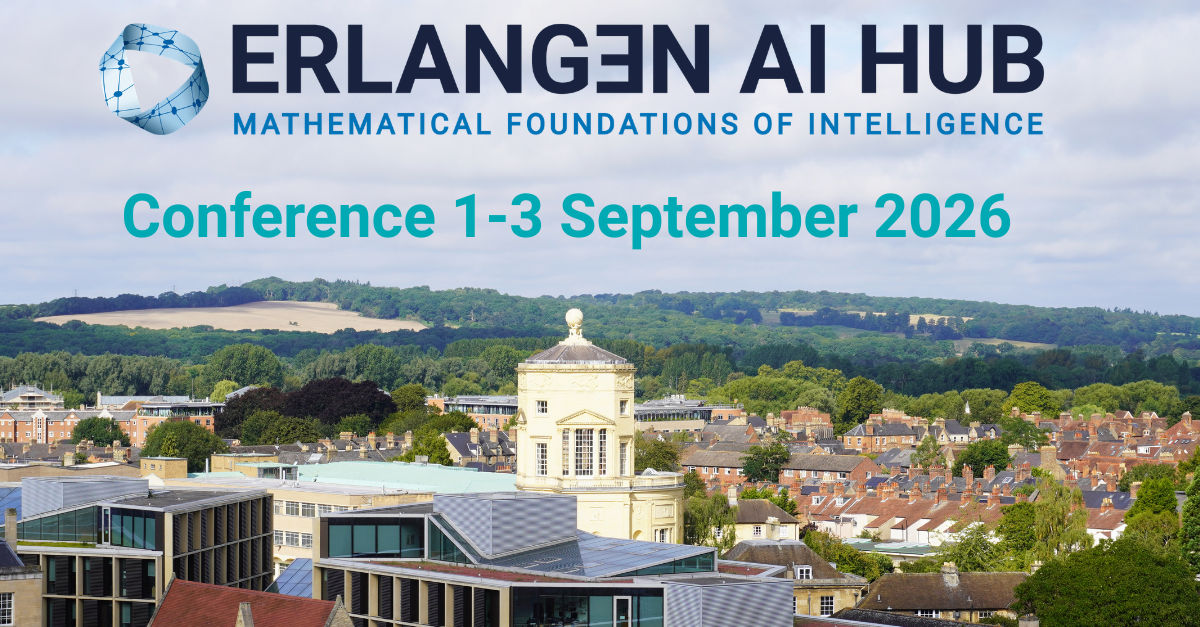
A finalised list of speakers for the Mathematical Foundations of AI Conference 2026 has almost been arrived at. The experts we have already secured stand at the intersection of mathematics, machine learning, artificial intelligence, geometry and topology. From pioneers of geometric deep learning and graph neural networks to leading researchers in topology, optimisation, formal proof verification, and relational AI, the conference will showcase cutting-edge ideas shaping the future of intelligent systems.
A list of the major speakers is included below. By the very nature of their wide-ranging contributions the following biographies have been edited for brevity.
Erik Bekkers
Erik Bekkers is an associate professor in Geometric Deep Learning in the Machine Learning Lab of the University of Amsterdam. His work emanates from the belief that as nearly all data is rooted in our physical world it is thus inherently grounded in geometry and physics and representation learning should preserve this grounding. His current research focuses on developing generalizations and efficient implementations of group equivariant architectures.
Michael Bronstein
The Erlangen AI Hub founder and co-director is a pioneer of geometric deep learning and graph neural networks. In addition, Michael Bronstein is DeepMind Professor of AI at the University of Oxford, Erlangen AI Hub Director and Founding Scientific Director of AI at AITHYRA. His work bridges academia and industry, shaping the future of non-Euclidean machine learning and AI innovation.
Rebekka Burkholz
Rebekka Burkholz is a tenured faculty member at the CISPA Helmholtz Center for Information Security, researching relational machine learning. Her main goal is to gain a theoretical understanding of deep learning from a complex network perspective and improve contemporary algorithms based on these insights. Her current applications focus on molecular biology. Before joining CISPA in 2021, she worked at the Biostatistics Department of the Harvard TH Chan School of Public Health.
Kevin Buzzard
Professor of Pure Mathematics at Imperial, Kevin Buzzard won the London Mathematical Society’s Whitehead Prize in 2002 and the Senior Berwick Prize in 2008. In 2017 he started formalizing mathematics and in 2022 he gave a plenary lecture at the International Congress of Mathematicians on the topic. He is currently leading a project to formalize a proof of Fermat’s Last Theorem and will speak at the conference on what autoformalization means with regard to artificial intelligence.
Coralia Cartis
Coralia Cartis is Professor of Numerical Optimization, University of Oxford, an internationally recognised mathematician whose research focuses on the theory, complexity and implementation of optimisation algorithms central to modern machine learning. A SIAM and EUROPT Fellow, she has made influential contributions to non-convex optimisation, derivative-free methods and large-scale computational mathematics. Cartis’s research bridges optimisation theory and AI applications, with expertise in numerical optimisation and machine learning algorithms.
Holly Francois
Holly Francois is Principal for Data Innovation (Machine Learning) at Ofcom, the UK’s communications regulator. She leads machine learning for online safety, combining AI research with regulatory practice. She has an extensive track record in international standards (3GPP, ITU-T and ETSI), and AI, with expertise spanning deep learning, transformers, speech recognition and generative AI.
Peter Grindrod
Peter Grindrod CBE is CEO of Astut Ltd, Professor of Mathematics at the University of Oxford and a leading applied mathematician whose work has shaped the development of mathematical approaches to data science and artificial intelligence in the United Kingdom. A founding director of the Alan Turing Institute and co-investigator of the Erlangen AI Hub, he has championed the view that future advances in AI depend on deeper mathematical understanding rather than scale alone. His research connects theoretical mathematics with industrial and societal applications
Mariann Hardey
Professor Hardey is a leading expert in Human-AI interaction, digital accessibility and equity. Her work, including her pivotal role as an Associate Director in the new Leverhulme Centre for Algorithmic Life, and her focus on the theme of Being Human is driven by a profound vision of technology that serves everyone. Inspired by the insight of HG Wells into a future shaped by innovation, her research focuses on harnessing the power of technology to empower individuals and communities. Professor Hardey is also part of Advanced Research Computing (ARC) at Durham University.
Heather Harrington
Professor of Mathematics, University of Oxford and Director of the Max Planck Institute of Molecular Cell Biology and Genetics in Dresden, Heather Harrington is an applied mathematician whose research sits at the intersection of topology, algebra, statistics, and machine learning. She is also Co-Director of the Centre for Topological Data Analysis and has pioneered mathematical methods for extracting structure from complex, high-dimensional data. A Royal Society Research Fellow and recipient of major awards including the Whitehead and Adams Prizes.
Kathryn Hess
Kathryn Hess is a leading mathematician known for her work in homotopy theory, category theory, and algebraic topology, as well as for applying topology to neuroscience, cancer biology, and materials science. Professor at École Polytechnique Fédérale de Lausanne, she is also a member of the Swiss Academy of Engineering Sciences, a Fellow of the American Mathematical Society and the Association for Women in Mathematics.
Stefanie Jegelka
Humboldt Professor at TU Munich and a Visiting Associate Professor at MIT EECS , Stefanie Jagielka’s research investigates the combinatorial, geometric, and algebraic foundations of machine learning. This includes learning with discrete objects, such as graphs or sets; learning with symmetries; discrete probability; learning with limited supervision, and the interplay of discrete and continuous optimization. She was a postdoc at UC Berkeley and obtained her PhD from ETH Zurich and the Max Planck Institute for Intelligent Systems.
Roland Kwitt
Professor of Machine Learning within the Department of Artificial Intelligence and Human Interfaces (AIHI) at the University of Salzburg (PLUS), Roland Kwitt is also currently deputy head there. Prior to that, he was part of the medical imaging and computer vision group at Kitware Inc., North Carolina, USA. His research spans multiple areas, but mostly focusses on theoretical and practical aspects of learning methods that allow the leverage and control structural characteristics of data. He is also a member of the ELLIS society.
Richard Lane
Richard is a Principal Data Scientist and Chartered Engineer at QinetiQ with 25 years’ experience in applying statistical and signal processing techniques to defence and security problems. Richard was awarded the John Benjamin Memorial Prize for his work on maritime anomaly detection and threat assessment, culminating in a demo to representatives from the Royal Navy, UK Border Agency and the Police. Richard has written over 130 journal and conference papers, patents and technical reports and was awarded a QinetiQ Fellowship in recognition of this and his project delivery record.
Yue Ren
Associate Professor, Durham University and UKRI Future Leaders Fellow, Yue Ren is a mathematician whose research connects algebraic geometry, tropical geometry and machine learning. He is a leading developer of mathematical software systems including Polymake, Singular, and OSCAR, and explores how geometric and algebraic structures can illuminate the behaviour of neural networks and learning algorithms. His work brings rigorous mathematical tools to problems in AI, polynomial system solving and scientific computing, with expertise in tropical geometry and geometric machine learning.
Suvrit Sra
Suvrit Sra is Career Development Associate Professor of EECS MIT and Professor for Resource Aware Machine Learning at TU Munich. A main component of his research on the mathematics of AI is optimization for machine learning, especially non-convex optimization including non-Euclidean and geometric optimization. Other key topics of interest include: discrete probability, theory of deep learning, theory of sampling, convex geometry, polynomials, combinatorics, etc.
Marika Taylor
Marika Taylor is Head of the College of Engineering and Physical Sciences and Pro Vice Chanceller at the University of Birmingham. She is also Professor of Theoretical Physics whose recent work extends into the mathematical foundations of artificial intelligence. Originally renowned for contributions to string theory, holography and geometry, she has increasingly focused on geometric AI and mathematically principled approaches to machine learning. As a Fellow of the Alan Turing Institute, she promotes interdisciplinary research linking advanced mathematics, physics and data science.
George Williamson
George Williamson is CEO of The Alan Turing Institute. Prior to this, from 2021, George was CEO of HMGCC (His Majesty’s Government Communications Centre), leading the organisation’s work to create tools and technologies for the national security community. George previously held a series of senior roles within the Foreign, Commonwealth and Development Office (FCDO), most recently as a Director General in Technology, serving in the UK’s diplomatic service for over 20 years, with roles in both the UK and overseas. George holds a DPhil from Oxford, was a Kennedy Memorial Scholar at Harvard University, and was Lecturer in Ancient History at Corpus Christi College, Oxford.
Register now to reserve your place at the conference and follow us for further speaker announcements over the coming weeks.