Erlangen AI Hub Industry Day: Connecting Academia and Industry

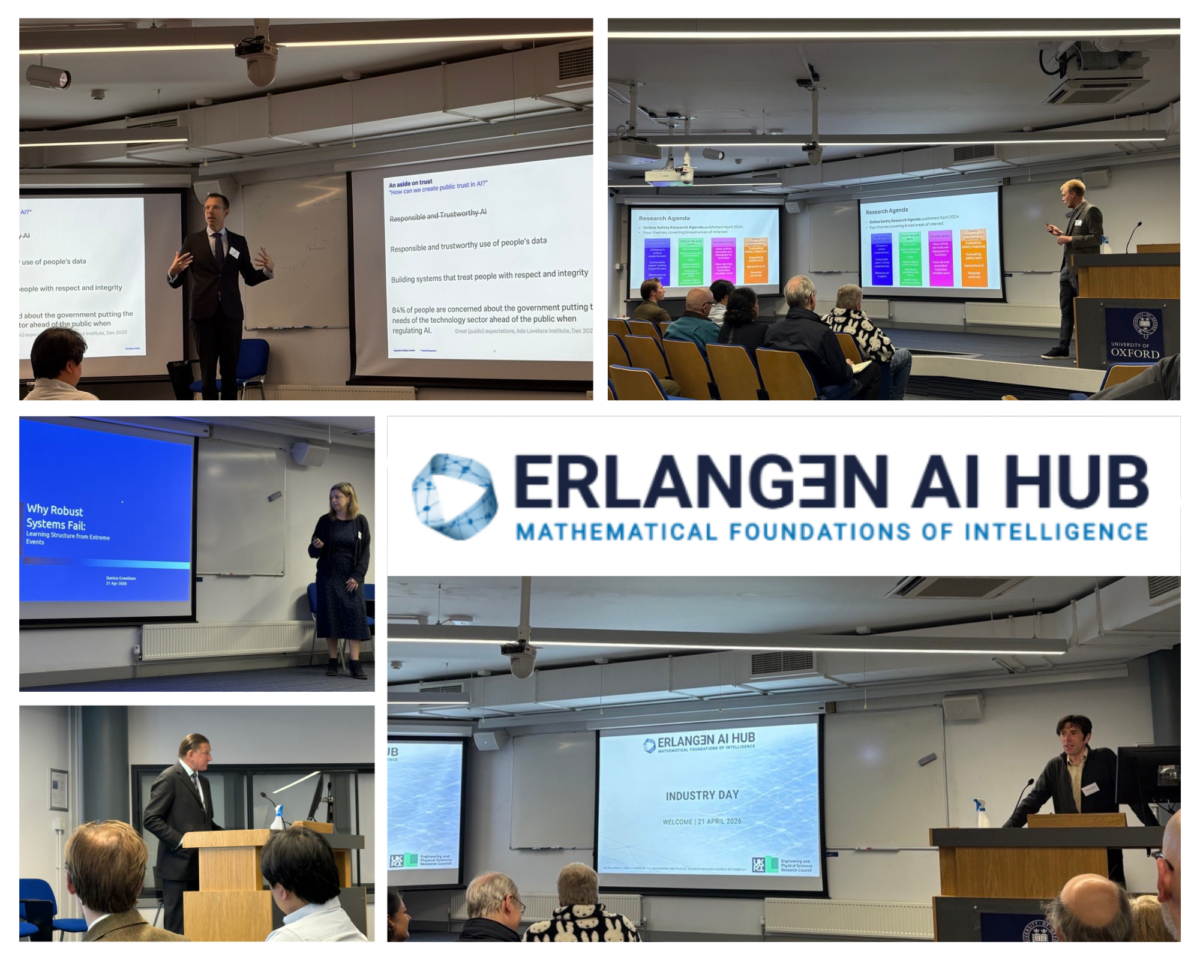
On Tuesday 21 April, the Erlangen AI Hub hosted an Industry Collaboration Day at the Department of Computer Science, University of Oxford. The event brought together academics from across the Hub network alongside leading industry partners, creating a valuable space for discussion, knowledge exchange and future collaboration.

The day opened with a welcome from Jeff Giansiracusa, Professor of Mathematics at Durham University. We were joined by an outstanding group of industry speakers, including Dr Carl Hunter (Durham Institute of Research, Development and Invention), Andreas Haggman (Ofcom), Danica Greetham (Capgemini Engineering), Francis Bursa (Oxford Nanopore Technologies) and Marco Albanese (Oxford Drug Design).

Academic perspectives were provided by Tom Coates, Professor of Mathematics at Imperial College London, and Pete Grindrod, Professor of Mathematics, University of Oxford.

The morning sessions highlighted the breadth of challenges and opportunities at the intersection of AI and industry. Topics ranged from online safety and the societal risks of AI, to the importance of sovereign AI capabilities in the UK and the role of collaboration between government, science and industry. Speakers also explored how AI is being applied to analyse complex data, identify patterns and accelerate progress in science and engineering.

Discussions continued over lunch, with participants exchanging ideas on future collaborations and exploring how partnerships between academia and industry can drive innovation and real-world impact.

In the afternoon, attendees worked in groups to develop ideas inspired by the morning sessions. These discussions generated a number of thought-provoking themes, including:

  • The evolving relationship between AI and philosophy, and whether the field is returning to its conceptual roots
  • Challenges in modelling complex, noisy and temporal data, and improving interpretability
  • The economics of benchmarking AI models and the risks of overfitting to established benchmarks
  • The role of domain expertise in mitigating risks for less-informed users of AI systems
  • Advances in machine learning for recognising complex patterns and improving sequencing accuracy

The day concluded with a panel discussion featuring Marika Taylor (University of Southampton), Ran Levi (University of Aberdeen) and Yue Ren (Durham University), who reflected on the future of AI and industry. The panel explored emerging challenges, key research questions, and how collaboration can deepen understanding of both mathematics and AI, while shaping their applications in industry.

The event received excellent feedback from participants. As Danica Greetham (Capgemini Engineering) noted:

“What stood out was the quality of the discussion afterwards—sharp questions and open exchanges with academics keen to dive quickly into the essence of problems. It was great to hear from other industrial partners about the challenges they’re tackling. A recurring theme: observational data doesn’t lie—but it rarely speaks plainly. Interpretation is where the real work happens.”

We look forward to our next major event where we can continue the conversations, Mathematical Foundations of AI: The Erlangen Hub Conference 2026, taking place from 1–3 September 2026 at the Mathematical Institute, University of Oxford. Early bird tickets are now available.

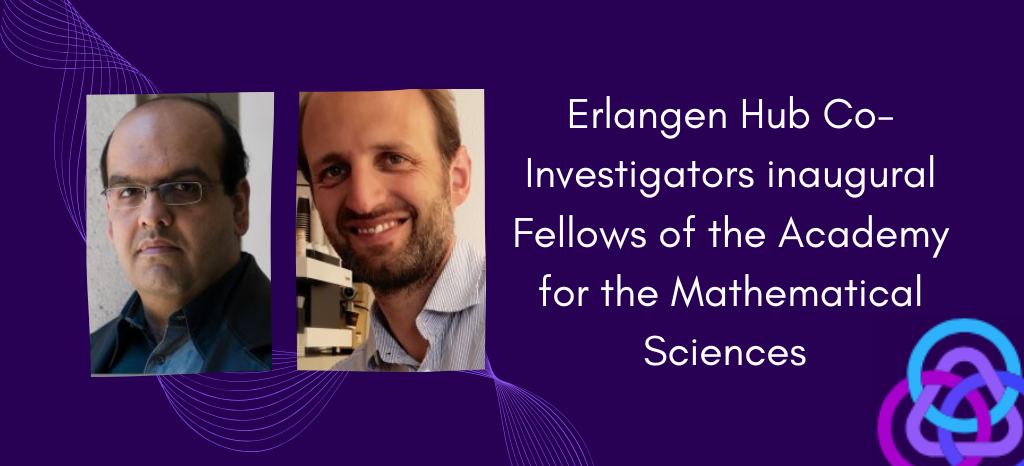
Erlangen Hub Co-Investigators elected inaugural Fellows of the Academy for the Mathematical Sciences

Erlangen Hub Co-Investigators Rama Cont and Christoph Reisinger have been elected to the inaugural cohort of Fellows of the newly founded Academy for the Mathematical Sciences. Their election recognises their leadership and contributions to the mathematical sciences and marks a significant milestone for both individuals and the Hub.

The Academy for the Mathematical Sciences brings mathematics to the centre of UK research, policy, and public life, advancing the discipline across multiple domains, including policy, education, research, and innovation. Sitting alongside other national academies, including the British Academy and the Academy of Medical Sciences, it will use its convening power to bring together experts to collaborate on major global challenges. These include climate change, national security, financial systems, and artificial intelligence.

The Fellowship comprises leading mathematicians from across academia, education, industry, business, and government, and includes Fields Medallists, senior figures in national security, and pioneers in computing and AI. The election of Rama and Christoph recognises their achievements and expertise within this distinguished community.

Rama Cont is Professor of Mathematics at the University of Oxford’s Mathematical Institute, Head of the Mathematical and Computational Finance Group, and a Fellow of St Hugh’s College. He also directs the Centre for Doctoral Training in Mathematics of Random Systems. His research spans stochastic computational methods, the mathematical foundations of AI, generative models, and data-driven modelling in finance. Alongside his academic work, Rama advises several AI-focused start-ups, including InstaDeep, 73Strings, and Synthera.AI. Through the Erlangen Hub, he contributes to strengthening the mathematical foundations that underpin modern AI systems and their applications. On knowledge of the election Rama said:

The Academy for the Mathematical Sciences’ ambitions are to represent and promote the full spectrum of mathematical sciences and their applications. As a mathematician with research activities spanning theory and applications, I am delighted to join the Academy as a Fellow.’

Christoph Reisinger is Professor of Applied Mathematics at the University of Oxford and specialises in stochastic simulation and control, mean-field models, and the mathematical foundations of deep learning. He collaborates closely with industry and government partners on challenges in AI security, air traffic control, and financial market microstructure. Within the Erlangen Hub, Christoph advances fundamental research at the interface of control theory and reinforcement learning, supporting the development of robust and reliable AI decision-making.

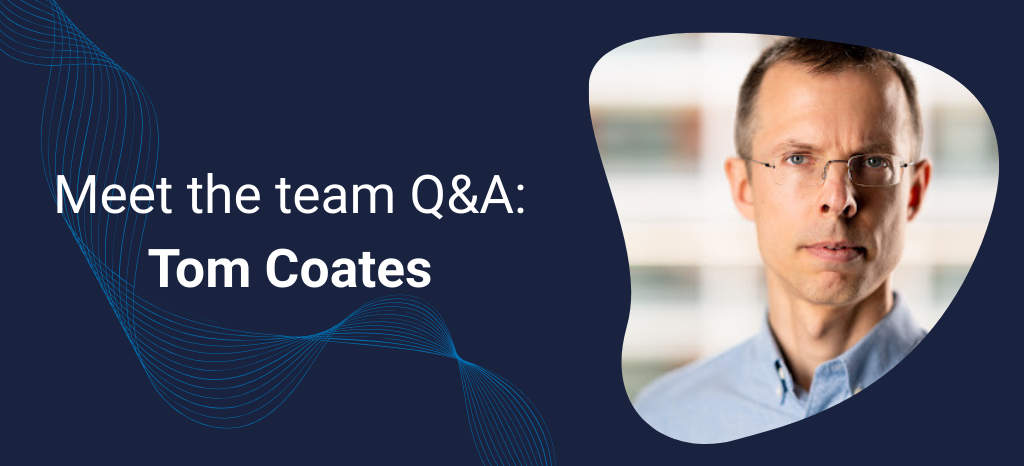
Meet the Team Q&A: Tom Coates

I was blown away by how powerful AI tools can be for theorem discovery. It’s impossible to spend a lot of time using these tools, and their more powerful LLM cousins, without becoming intensely curious about how they work and how to reason about them.


In this edition of our Meet the Team Q&A we sat down with Tom Coates. Tom is a Professor of Pure Mathematics at Imperial College London. He is also an Erlangen Hub Co-Investigator and Theme D Deputy Lead focusing on the development of autonomous, self-adaptive AI that uses formal methods to understand its limits, and act safely and ethically.

Can you share a bit about your background and your current research focus?

For the past decade or more, I have been involved in a large-scale collaboration to find and classify algebraic varieties called Fano manifolds — one can think of this as building a “Periodic Table” for shapes. This collaboration involves a lot of large-scale computation, data mining, and machine learning, which is how I got interested in AI as a tool for scientific discovery. More recently I have also been on part-time secondment to the Office of the Chief Scientific Adviser, which has led to my current focus on the interface between AI and policy.

What inspired you to pursue this area?

Originally I was attracted by a purely theoretical, purely mathematical question: how to find the “basic pieces” from which more complex geometries are made. But as we began to deploy machine learning and AI-powered pipelines to tackle this question, I was blown away by how powerful AI tools can be for theorem discovery. And it is not possible to spend a lot of time using these tools, and their more powerful LLM cousins, without becoming intensely curious about how they work and how to reason about them.

Which themes are you connected to within the Erlangen AI Hub and how does your work within the hub intersect with your research background?

I lead on the Government Engagement and Theme D.

What attracted you to the Erlangen AI Hub and what do you hope to see it achieve?

There is such a need for more mathematicians with the skills to work at the interface between AI and policy. The Erlangen Hub is a perfect opportunity to pilot interventions in this space, and to support and grow more early career researchers who are “bilingual” — communicating fluently with both policymakers and scientists in AI and adjacent fields.

What’s been the most surprising or exciting finding in your work so far?

I’ve been enormously proud of the work that Sara Veneziale and I have done developing and delivering training courses on the fundamentals of AI to civil servants. More than 250 civil servants in at least 15 departments to date! This is having a demonstrable impact on policy formulation and delivery, in an area that is critical to both security and economic growth.

What challenges have you faced in your research, and how did you overcome them?

I have been very fortunate to work with an incredible group of collaborators across my career. There have been challenges here and there, but also amazingly creative colleagues to help overcome them.

What advice would you give to someone just starting out in your field?

Get stuck into the practicalities of AI: training large models, fighting the data-cleaning pipeline, wrangling the GPUs. There is no substitute for practical experience — and it helps you to choose and formulate the correct research questions too.