Mathematics and the Future of AI

Intellectual leadership through deep foundations

In a new University of Oxford Expert Comment article, Erlangen AI Hub Co-Investigator Professor Peter Grindrod CBE, argues that mathematics is not peripheral to artificial intelligence, but central to solving its core challenges.

As AI systems increase in scale and complexity, concerns around reliability, bias, interpretability, and formal guarantees cannot be addressed by engineering alone. Mathematics provides the structure to reason rigorously about uncertainty, optimisation, stability, and limits. Through probability, geometry, topology, dynamical systems, and information theory, maths enables AI systems that are interpretable by design and grounded in provable principles.

At the Erlangen AI Hub, Professor Grindrod and colleagues are working precisely in this space: bringing deep mathematical ideas into direct engagement with real-world AI challenges. Maths provides the foundation to build systems that are more robust, transparent, and intellectually grounded, helping position the UK as a leader through intellectual depth rather than scale. Read the full article below.

Expert Comment: How and why mathematics will both underpin and lead the next generation of AI | University of Oxford

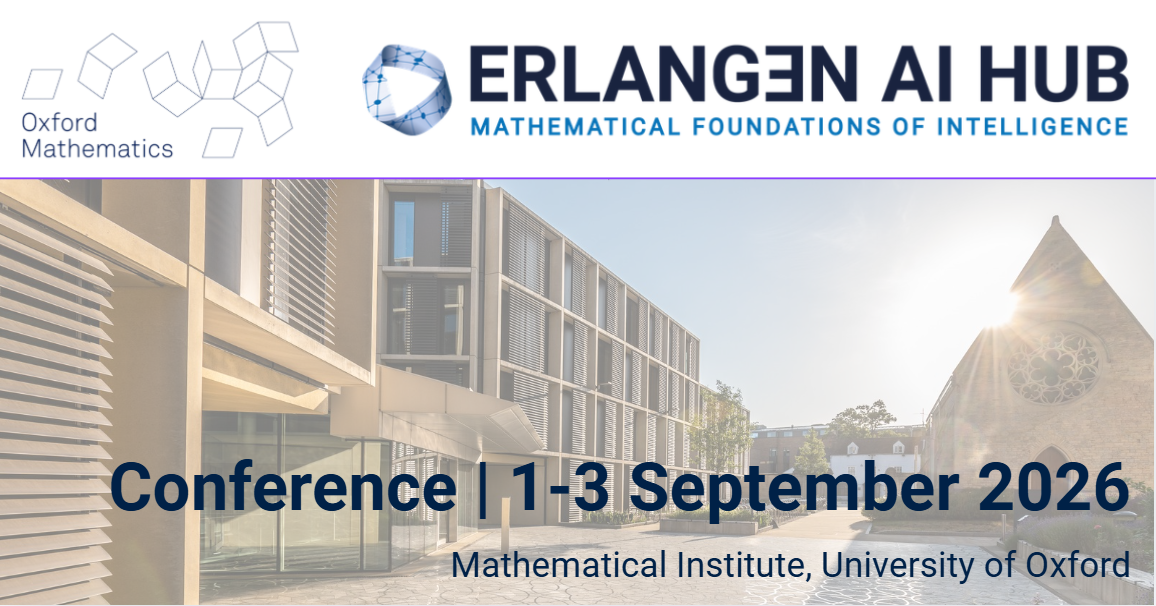
Mathematical Foundations of AI: The Erlangen Hub Conference 2026

Our annual public conference will bring together leading researchers, innovators, and thinkers at the forefront of artificial intelligence.

As AI advances rapidly, our understanding struggles to keep pace. Mathematics—both pure and applied—plays a critical role in closing this gap, with even abstract ideas shaping modern AI.

This conference convenes researchers and industry leaders to foster open, collaborative discussions on making AI more understandable, reliable, and impactful.

The programme includes:
  • Plenary talks from leading researchers
  • Short talks and industry perspectives
  • Poster sessions and lightning talks
  • A panel discussion on future directions

Participants are invited to submit a poster showcasing a research project or collaboration (A0 size). You may also opt to present a 2-minute lightning talk prior to lunch break. Indicate your interest when registering.

Register Now

Ticket prices
Early Bird:

  • Conference: £90
  • Conference + Dinner on 1st September: £160

Full Price:

    • Conference: £120
    • Conference + Dinner on 1st September: £190

Early bird rates are available until 29 May.

Tickets include refreshments and lunch across all three days. The optional conference dinner will be held at an Oxford College, Lady Margaret Hall, on the first evening. Reduced pricing has been made possible through the generous support of the Mathematical Institute.

Plenary speakers (further speakers will be added as they are confirmed)