New PDRAs join Erlangen AI Hub

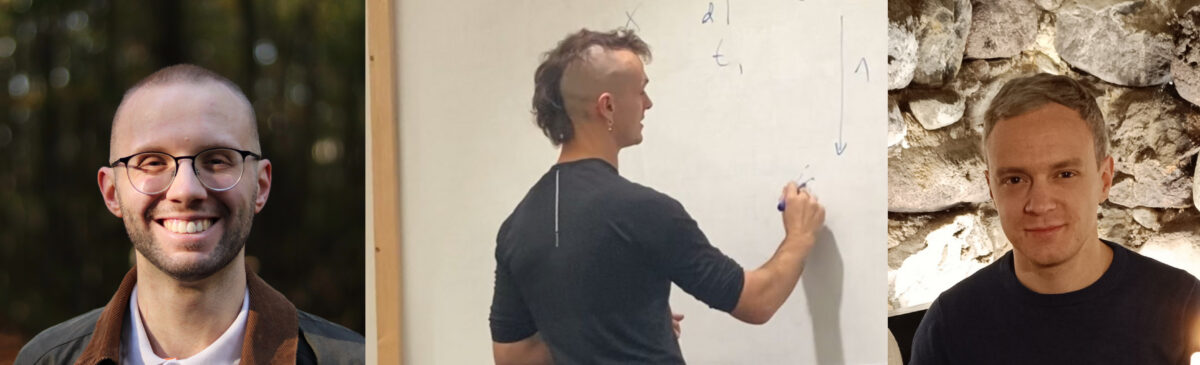
A very warm welcome to the Erlangen AI Hub to our three new PDRAs who joined us in September: Konstantin Kueffner, Kelly Maggs, Gianmarco Parretti. They join a growing team of PDRAs across our University of Oxford departments (Mathematical Institute and Department of Computer Science), and we are delighted to have them on board.

Kelly Maggs completed a PhD in algebraic topology at EPFL where his supervisor was Kathryn Hess. He then transitioned to mathematical biology during a postdoc in Heather Harrington’s group at at the Max Planck Institute for Cell Biology and Genetics. His research goal is to develop a geometric, topological, and algebraic language for cellular processes compatible with modern machine learning.

Gianmarco Parretti’s research lies at the intersection of Artificial Intelligence and Formal Methods, aiming to improve the reasoning capabilities of autonomous agents. He received his PhD in AI at the University of Rome “La Sapienza” after defending a thesis titles Synthesis Under Environment Specifications for LTLf.

Konstantin Kueffner was a PhD student at the Institute of Science and Technology Austria, working under the supervision of Thomas A. Henzinger. His research lies in the intersection of formal verification, statistic, and machine learning, with a particular emphasis on uncertainty quantification. His research interests include: runtime verification, formal methods, stochastic processes amongst others.

We look forward to getting to know more about them and their work.

Mathematics and the Future of AI

Intellectual leadership through deep foundations

In a new University of Oxford Expert Comment article, Erlangen AI Hub Co-Investigator Professor Peter Grindrod CBE, argues that mathematics is not peripheral to artificial intelligence, but central to solving its core challenges.

As AI systems increase in scale and complexity, concerns around reliability, bias, interpretability, and formal guarantees cannot be addressed by engineering alone. Mathematics provides the structure to reason rigorously about uncertainty, optimisation, stability, and limits. Through probability, geometry, topology, dynamical systems, and information theory, maths enables AI systems that are interpretable by design and grounded in provable principles.

At the Erlangen AI Hub, Professor Grindrod and colleagues are working precisely in this space: bringing deep mathematical ideas into direct engagement with real-world AI challenges. Maths provides the foundation to build systems that are more robust, transparent, and intellectually grounded, helping position the UK as a leader through intellectual depth rather than scale. Read the full article below.

Expert Comment: How and why mathematics will both underpin and lead the next generation of AI | University of Oxford

Mathematical Foundations of AI:
The Erlangen Hub Conference 2026

Artificial intelligence has achieved remarkable success, yet we still lack a rigorous mathematical understanding of why modern AI systems work, and when they fail. Closing this gap is one of the defining scientific challenges at the intersection of mathematics and computer science. The Mathematical Foundations of AI: Erlangen Hub Conference 2026 will bring together leading researchers in geometry, algebra, topology, probability, dynamical systems, machine learning and related fields for an interdisciplinary exploration of the mathematical principles underlying modern AI. The conference aims to foster new connections across disciplines and advance the mathematical foundations needed to build more reliable, robust, and trustworthy AI systems.

Confirmed speakers:

For further details of speakers click here.