
Conference round-up

It’s conference season and hub members have been busy presenting work across the world. Take a look at a snapshot of activity below:
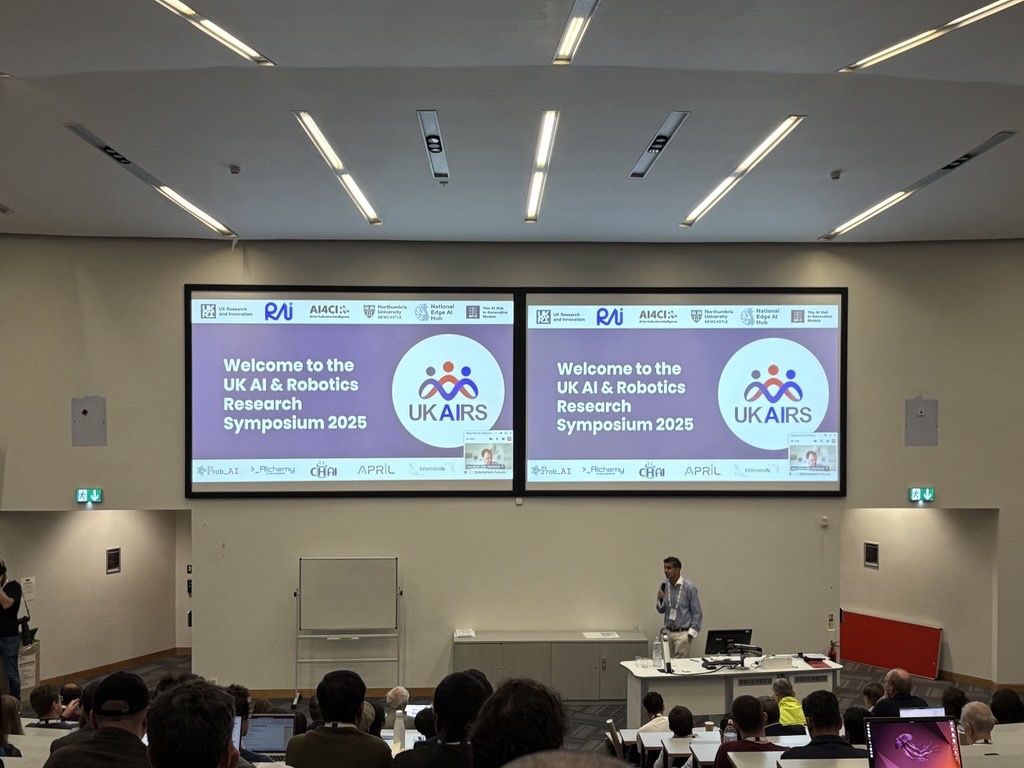
UK AI Research Symposium – September 2025, Northumbria University
Hub members took part in a fantastic two days at the UK AI Research Symposium (UKAIRS) at Northumbria University.
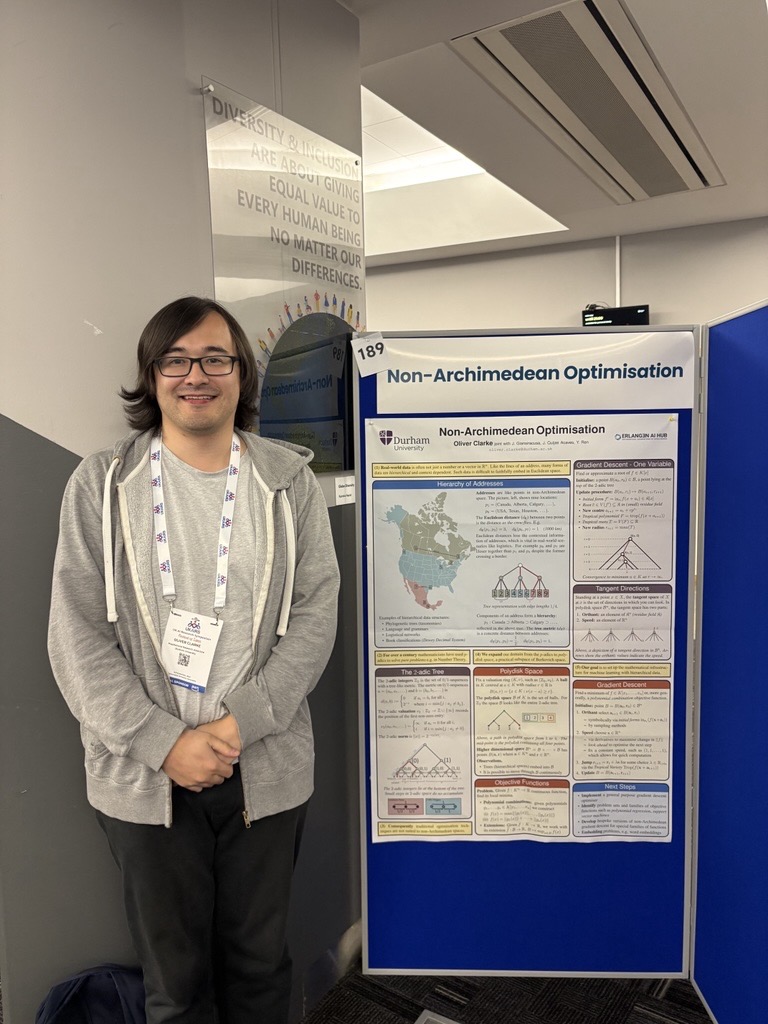
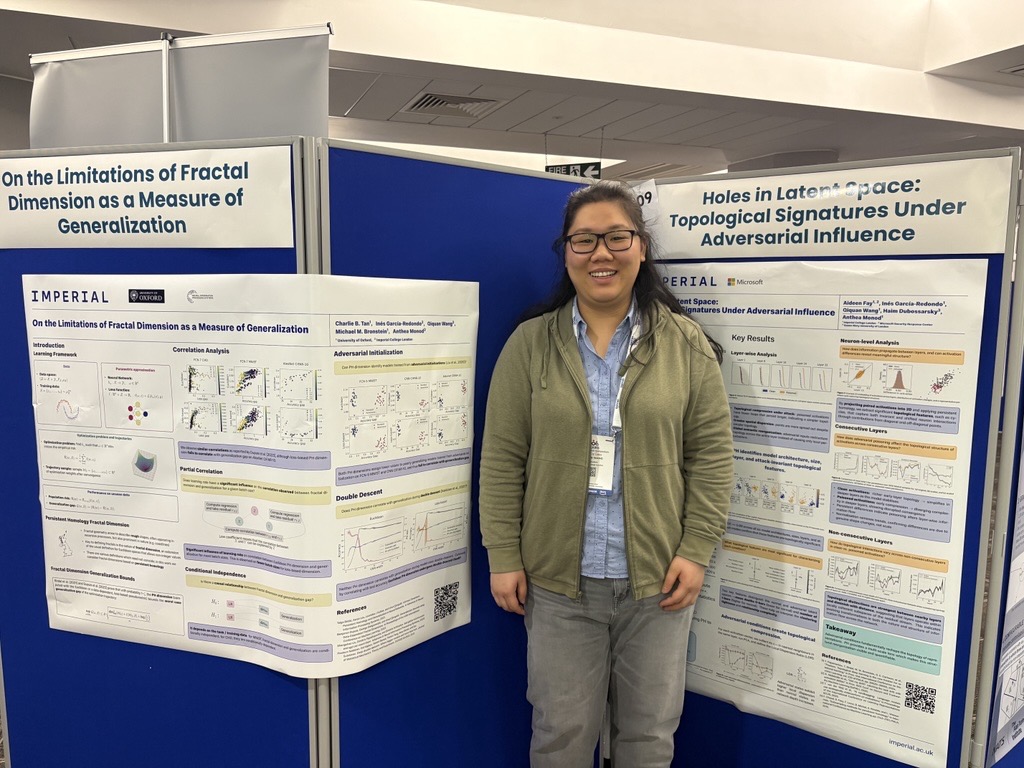
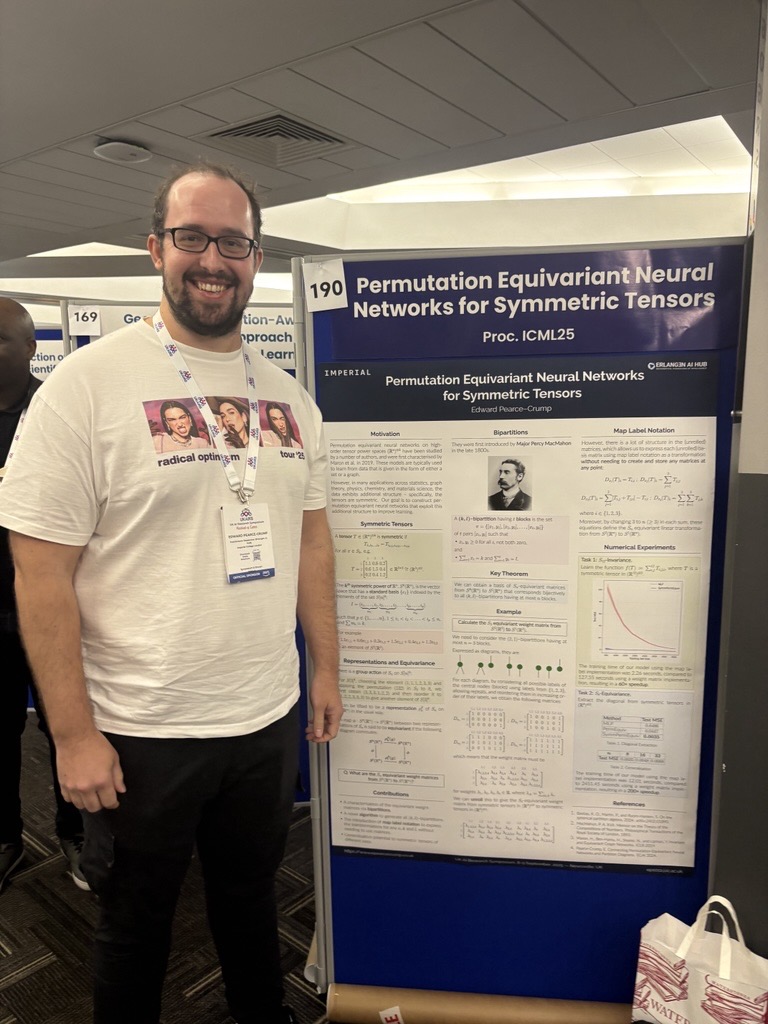
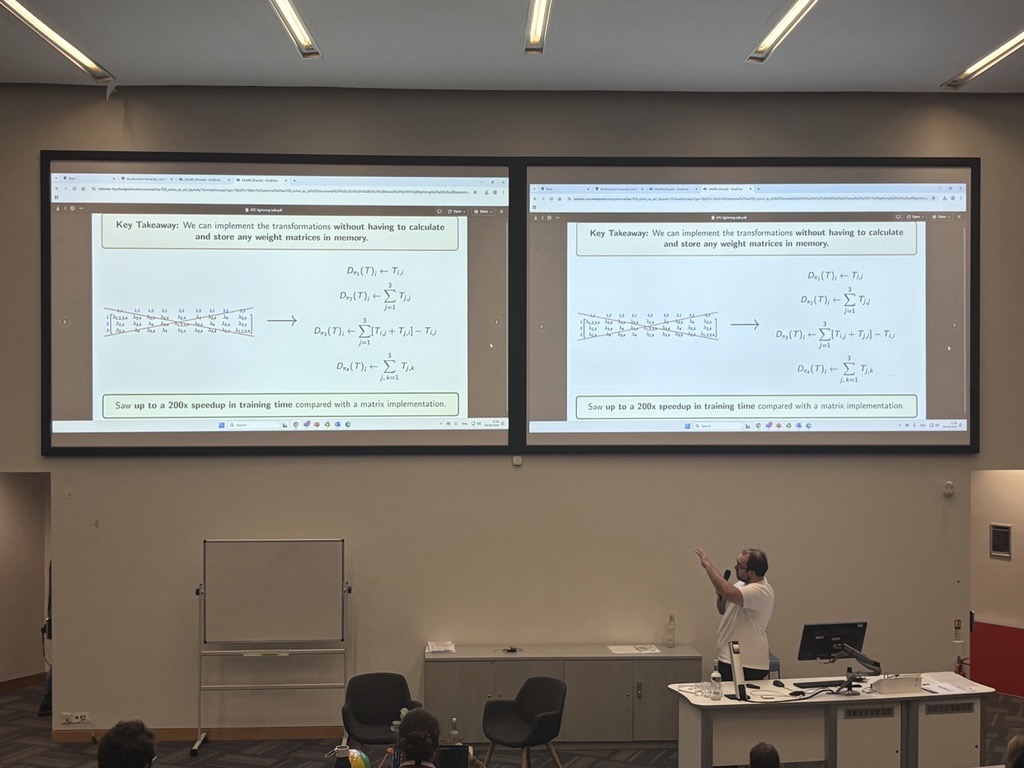
Congratulations to Oliver Clarke, Edward Pearce-Crump and Qiquan Wang, who presented their research during the poster sessions, and Edward who also gave a lightning talk on his research.
UKAIRS was a hugely inspiring event bringing together and consolidating the UK’s AI research community, with highly engaging talks, demos, panels, posters and keynotes across diverse disciplines, with reflections on the future of AI and emerging challenges. It was also a brilliant platform for our postdocs to showcase their research and meet peers from across the UK, facilitating connections and ideas-sharing with the wider AI research community, including the other EPSRC AI hubs. Many thanks to organisers Responsible Ai UK and the steering committee for their hard work putting the event together.
Applied Algebraic Topology Research Network (AATRN) conference – August 2025, Chicago
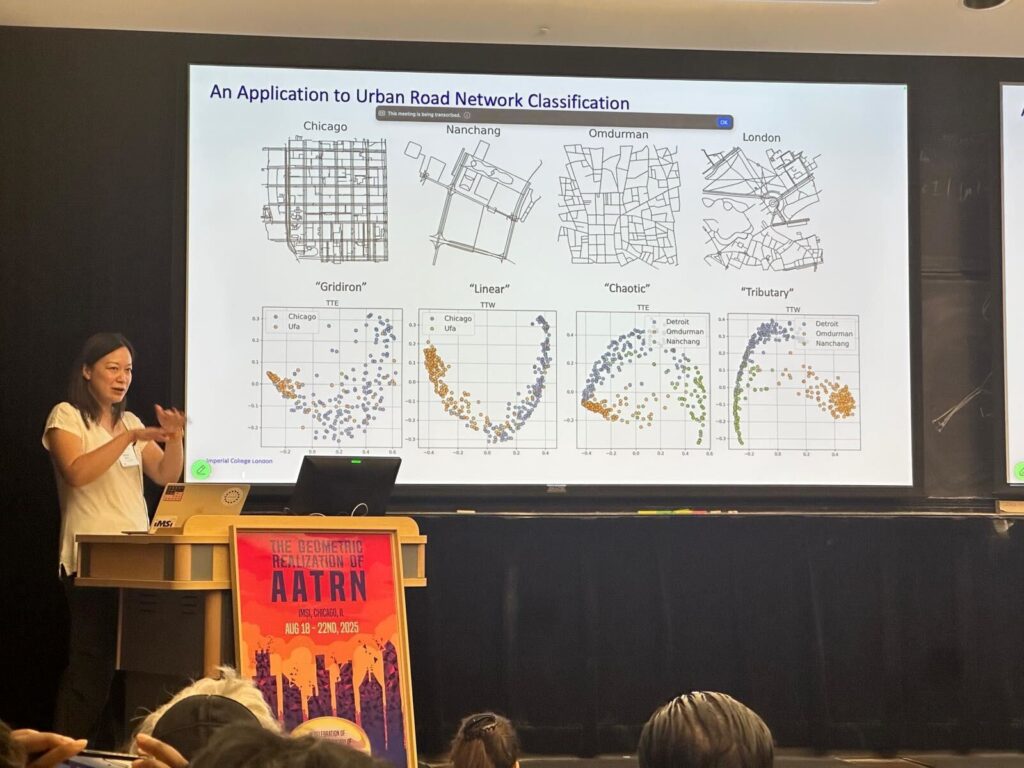
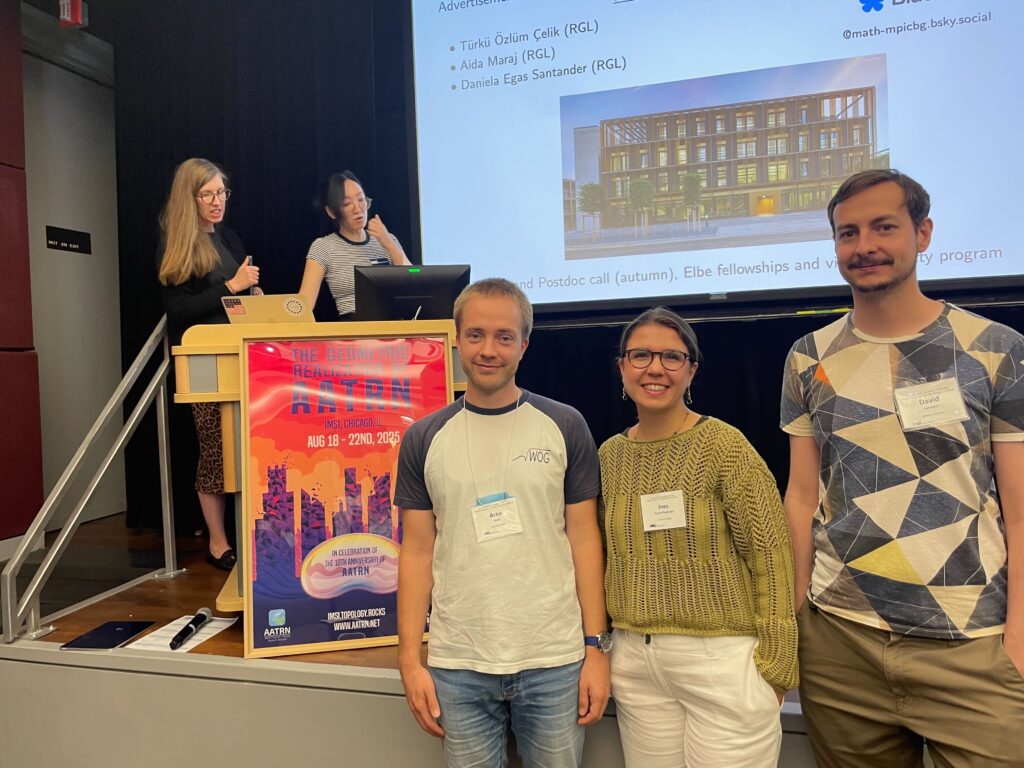
Several hub members attended a week-long conference in celebration of the 10-year anniversary of AATRN, the Applied Algebraic Topology Research Network, at the Institute for Mathematical and Statistical Innovation in Chicago.
Speakers included hub members Anthea Monod, Omer Bobrowski and Heather Harrington. They were accompanied by hub PhD students Arne Wolf, Inés Garcia-Redondo and David Lanners.
The event was AATRN’s first in-person meeting, bringing together researchers from mathematics, statistics, computer science, physics, biology, and beyond.



Graph Learning Meets Theoretical Computer Science workshop – August 2025, Berkeley
Anthea Monod was a speaker at the Graph Learning Meets Theoretical Computer Science workshop (co-chaired by Michael Bronstein) at the Simons Institute for the Theory of Computing at the University of California, Berkeley. She offered a Bootcamp on geometry and graph learning.
The workshop brought together researchers to provide a more unified perspective on graph learning within theoretical computer science.
International Joint Conference on Artificial Intelligence (IJCAI) – August 2025, Montreal
Guiseppe De Giacomo presented three papers at the International Joint Conference on Artificial Intelligence (IJCAI) 2025 in Montreal.
Read: LTLf+ and PPLTL+: Extending LTLf and PPLTL to Infinite Traces
Read: Solving MDPs with LTLf+ and PPLTL+ Temporal Objectives
Read: Computational Grounding of Responsibility Attribution and Anticipation in LTLf
SIAM (Society for Industrial and Applied Mathematics) conference – July 2025, Wisconsin
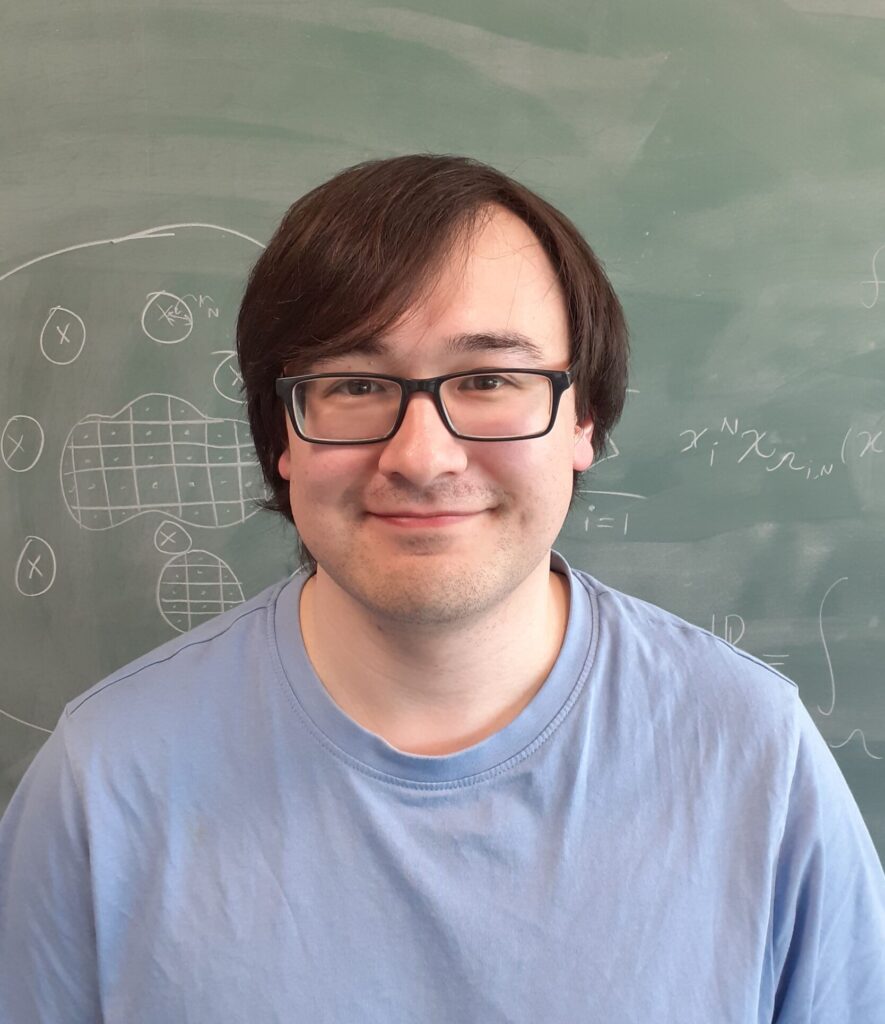
During the summer, Oliver Clarke presented his work at the SIAM (Society for Industrial and Applied Mathematics) 2025 Conference on Applied Algebraic Geometry in Madison, Wisconsin.
The SIAM Activity Group on Algebraic Geometry has a broad scope and brings together researchers using tools in commutative algebra, geometry, topology, combinatorics, computational algebra to solve ‘applied problems’ in areas such as biology, computer vision, machine learning, robotics, and statistics. The SIAM AG conference, which takes place every 2 years, is a chance to see what fellow researchers are working on through a series of parallel mini-symposia and plenary talks.
Oliver presented his work-in-progress alongside Yue Ren, Jeffrey Giansiracusa, and Julio Quijas-Acaves, with a talk entitled Towards non-Archimedean Machine Learning. The project is concerned with developing machine learning tools, for instance gradient descent, over non-Archimedean fields such as the p-adics. Oliver said:
“I was delighted with the attendance for my talk, presenting to a packed seminar room, which lead to fruitful conversations with experts in p-adics analysis and tropical geometry.”
The conference lasted 5 days, during which time Oliver attended around 50 talks, learning about many of the problems and techniques in applying algebraic geometry to machine learning. He added:
“It was an excellent opportunity and I’m looking forward to presenting some concrete results in the future.”
International Conference on Machine Learning (ICML) – July 2025, Vancouver
A team of researchers including Michael Bronstein won the best paper award at the ICML Generative AI and Biology (GenBio) workshop for FORT: Forward-Only Regression Training of Normalizing Flows.
Uzu Lim presented Cover Learning for Large-Scale Topology Representation at ICML. Authors of the joint paper also included Luis Scoccola and Heather Harrington, the hub’s Oxford Maths lead.
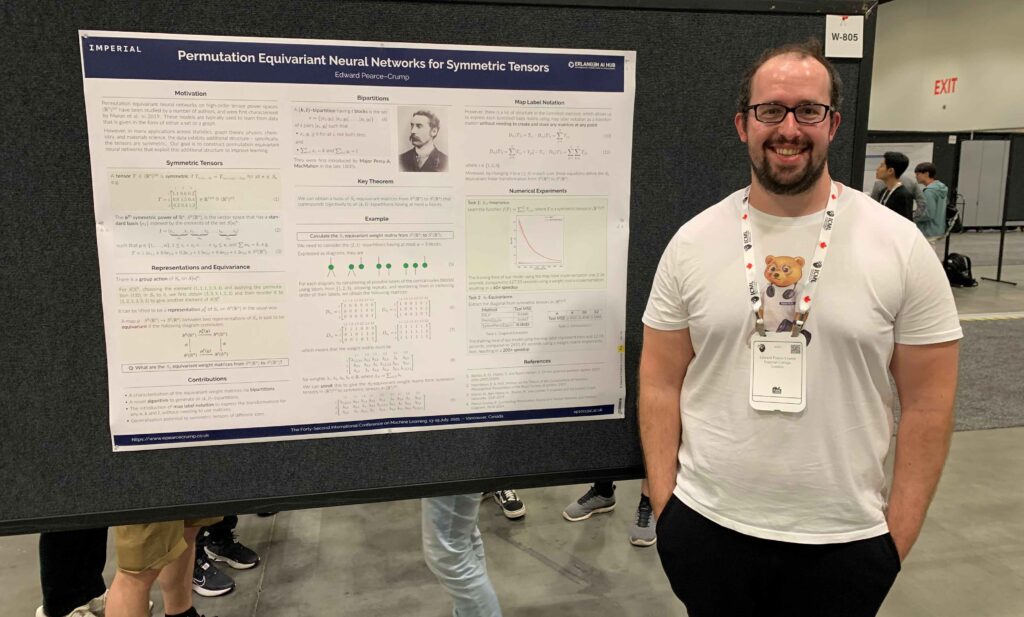
Edward Pearce-Crump (pictured above) presented his work Permutation Equivariant Neural Networks for Symmetric Tensors at ICML. Edward said:
“I’m delighted to have had the opportunity to present my work at ICML 2025 in Vancouver! The feedback I received was incredibly valuable and will guide me in my future research. It was also a pleasure to see old colleagues again and engage in thoughtful discussions about the latest advances in AI.”
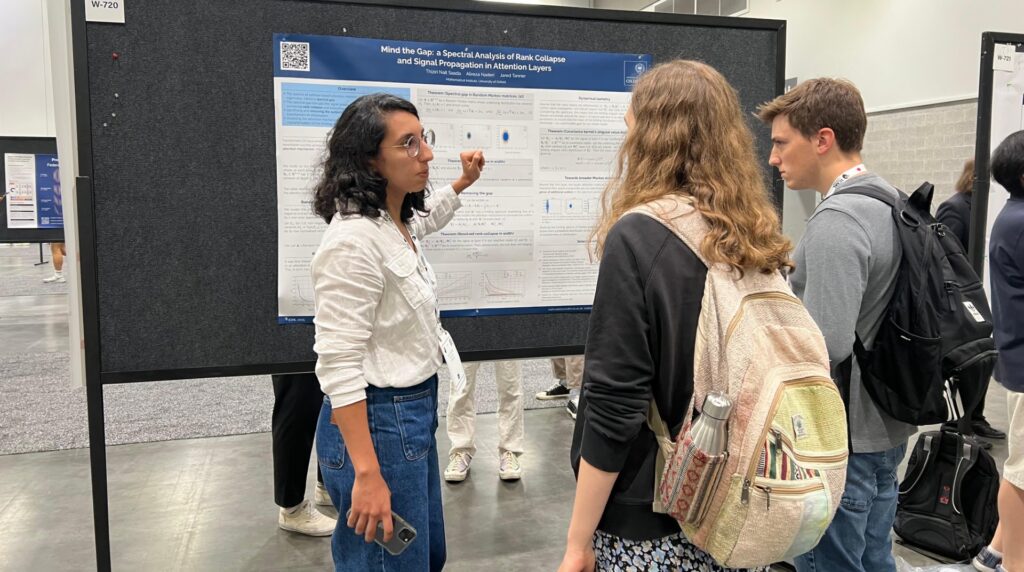
Doctoral student Thiziri Nait Saada presented work supported by the hub at ICML. Mind the Gap: a Spectral Analysis of Rank Collapse and Signal Propagation in Attention Layers was authored by Thiziri alongside Alireza Naderi and Jared Tanner.
International Conference on Computer-Aided Verification (CAV) – July 2025, Zagreb
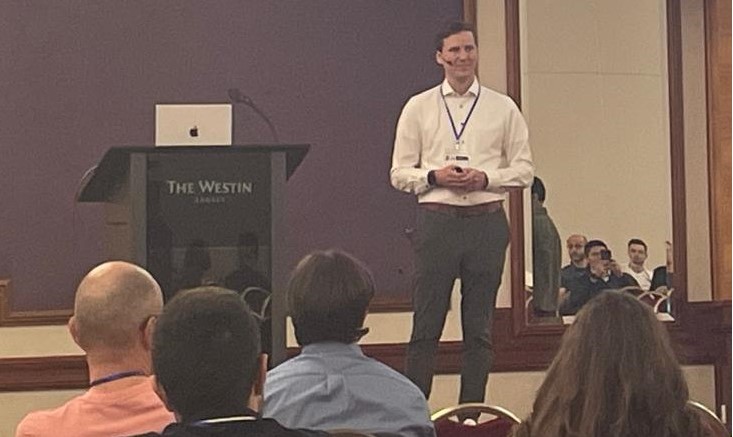
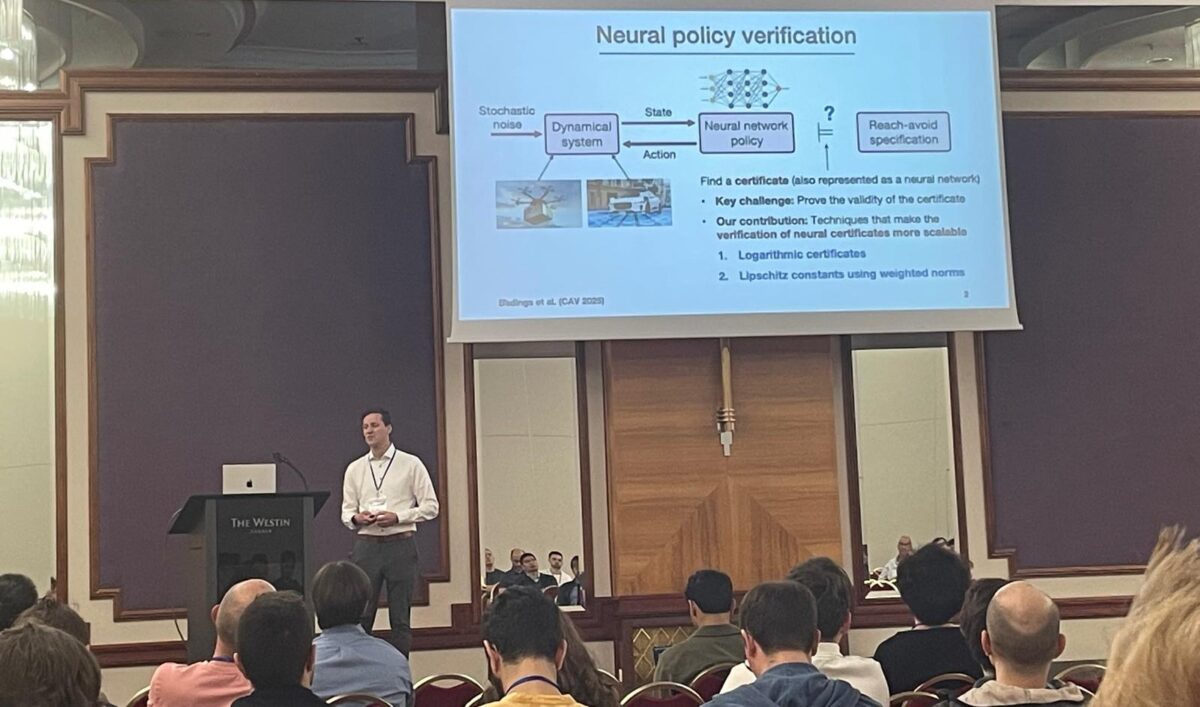
Thom Badings (pictured above) presented his work at CAV in July.
In the joint paper Policy Verification in Stochastic Dynamical Systems Using Logarithmic Neural Certificates his team developed novel techniques for the verification of neural network policies in stochastic dynamical systems.