
Mathematical Foundations of AI conference brings leading researchers to Oxford

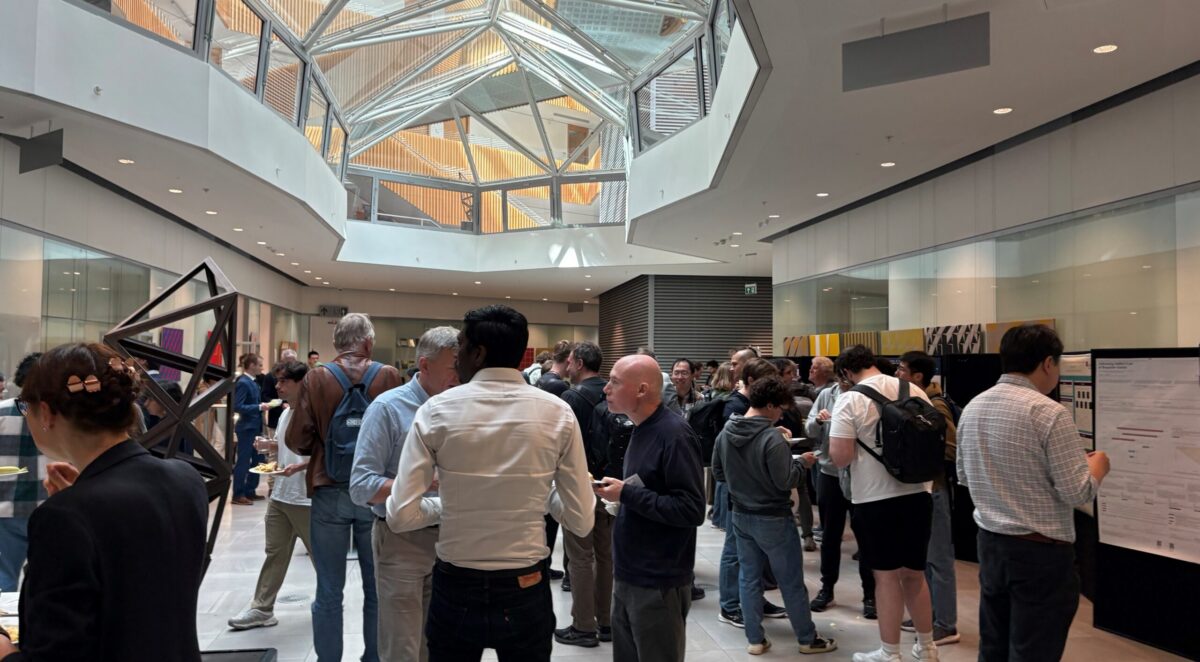
Against a backdrop of news stories about AI autonomy, leading mathematicians, computer scientists and AI researchers gathered in Oxford to discuss the future of AI. Speakers at the Erlangen AI Hub’s Mathematical Foundations of AI Conference 2026 explored how deeper mathematical understanding could help shape the next generation of artificial intelligence. Held at the University of Oxford’s Mathematical Institute from September 1-3, the three-day conference brought together researchers working across geometry, topology, optimisation, probability, machine learning and theoretical computer science.
The gathering addressed a problem increasingly central to AI research: modern machine-learning systems can achieve remarkable results but there remains a considerable gap between their practical capabilities and our theoretical understanding of why they work, how they generalise and under what circumstances they fail. Academics and industry specialists explored how they are using geometry in particular to investigate the underlying structures of artificial intelligence.
Across three days, speakers approached the problem from markedly different directions.
Erik Bekkers of the University of Amsterdam traced the idea emerging in Spinoza that the mind had deep geometric structures and how this might inform contemporary geometric deep learning. Marika Taylor, recently appointed Executive Dean Faculty of Mathematical and Physical Sciences, University College London, examined how physical principles including symmetry, locality and equations of motion can be incorporated directly into neural networks. Symmetry formed one of the conference’s strongest themes, with co-director Michael Bronstein using Philip Anderson’s statement that “It is only slightly overstating the case to say that physics is the study of symmetry.”
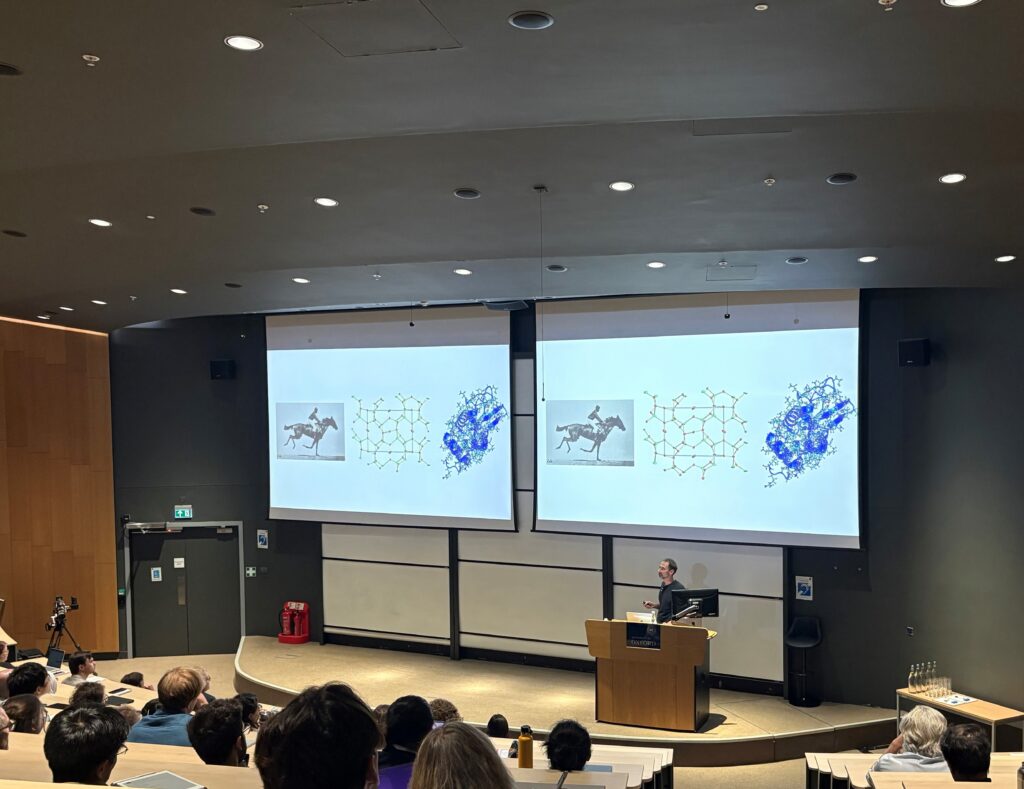
Other talks demonstrated the breadth of mathematics now being brought to bear on AI. Kathryn Hess of EPFL presented work on “ring scores”, mathematical measures for identifying circular structures in complex datasets, with possible applications to detecting cyclic processes in single-cell biological data. Roland Kwitt of the University of Salzburg considered the challenge of scaling persistent-homology techniques for large three-dimensional datasets while Yue Ren of Durham University presented a non-Archimedean approach to representing hierarchical data.
The conference also examined the relationship between mathematics and artificial intelligence from the opposite direction: how AI is increasingly becoming a tool for mathematics itself. Kevin Buzzard discussed autoformalisation — the use of AI to translate mathematics written by humans into formal languages such as Lean. Buzzard, who is leading a project to formalise a proof of Fermat’s Last Theorem, examined recent progress towards allowing machines to undertake parts of that translation automatically.
Questions of reliability repeatedly connected the theoretical discussions with practical applications. Richard Lane of QinetiQ examined probability calibration: whether the confidence reported by an AI system accurately corresponds to its real-world accuracy. Coralia Cartis, Professor of Numerical Optimization at Oxford, discussed mathematical connections between training data and the parameters of deep neural networks, including research into recovering training samples from trained networks.
The programme also moved beyond technical questions to consider how mathematically grounded AI might operate in society. George Williamson, CEO of the Alan Turing Institute, asked whether the mathematical foundations of AI should increasingly be regarded as a question of national infrastructure. As AI moves into power, defense and public services, he argued, understanding when systems remain predictable and when they fail becomes more than an abstract theoretical problem. The wider question was taken up by Peter Grindrod, Professor of Mathematics at Oxford , who argued that mathematics could play a decisive role in moving AI beyond systems based principally on correlation, towards systems whose reasoning and limitations can be better understood.
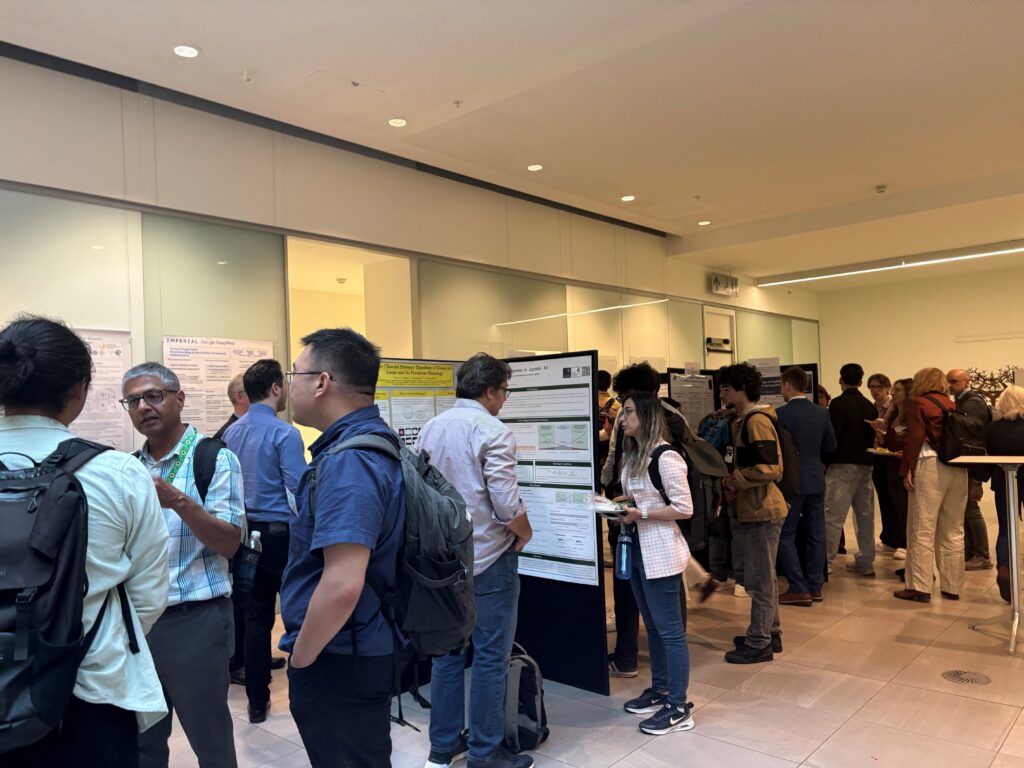
Much of the extraordinary progress in AI over the past decade has come from increasing quantities of data, computation and model parameters. The work presented in Oxford suggested another route to progress: understanding more precisely the mathematical structures that make learning possible in the first place. Across talks, lightning sessions, posters and panel discussions, the conference brought these theoretical questions into contact with problems of interpretability, robustness, scientific discovery, regulation and human judgement.